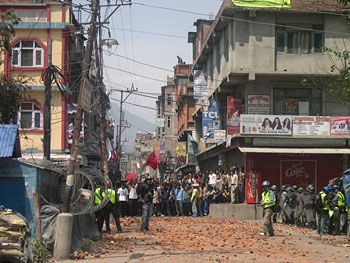
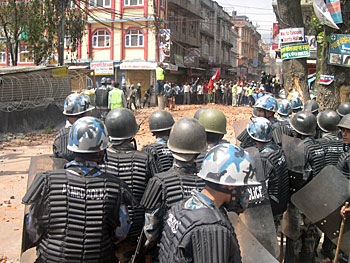
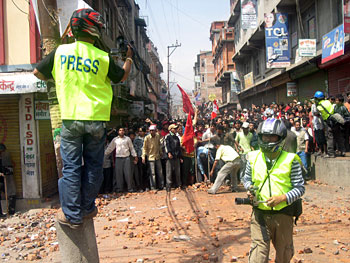
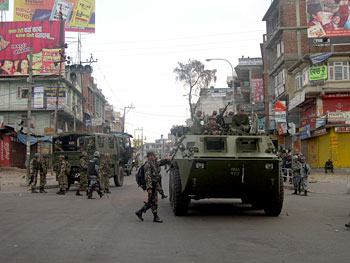
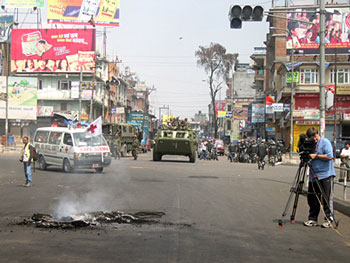
Demonstrations and protests continue throughout the nation as we write this report with thousands of professionals, civil servants and the general public defying curfew orders to come out in the streets. Reports are coming in of the protests spreading to more locations in the country with even civil servants joining in the agitation.
The eastern parts of the country which had until today seen fewer protests have also seen demonstrations with large rallies in Biratnagar, Dharan, and Ithari. Clashes between protesters and security forces are taking place in the Bhaktapur, Kirtipur, Gangabu, and Kalanki in Kathmandu Valley. Even so, the intensity of the protests appear to have reduced compared to Sunday and the curfew has been reduced by six hours. The political party leadership which has spearheaded the agitation with tacit backing of the Maoists appear to be concerned that the protests shouldn't get out of hand.
Demonstrations going out of control, analysts say, would invite an anarchic situation that the state could use to declare a state of emergency or the Maoists to launch an urban uprising. The party leadership also appears to think it would be politically more effective to have large centralised pro-democracy rallies than sporadic stone-throwing crowds at street corners. The parties also seem to be wary that an extended general strike would not be popular with the public which is already reeling under shortages and price rises after the four-day strike and curfews. The parties also seem wary of the government using escalating violence to prove that the demonstrations have been infiltrated by Maoists.