
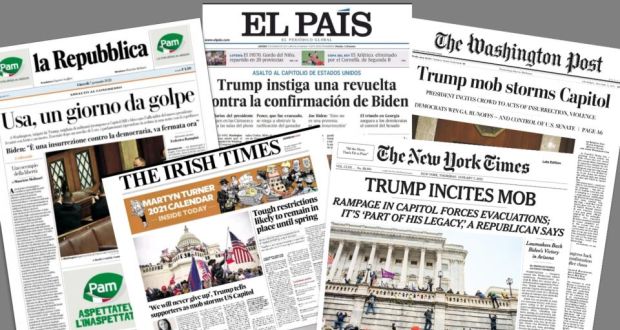
The 6 January at the US Capitol lacked the gravitas of the storming of the Winter Palace in Petrograd in 1917 during the October Revolution.
Incited by President Donald Trump at a nearby rally, where he encouraged his supporters to march on the US Capitol, the mob did succeed in interrupting a joint session of Congress to confirm the Electoral College vote in favor of President-elect Joe Biden. But lawmakers will still carry out their constitutional duty, and Biden’s inauguration will take place next week.
The insurrectionists were nowhere near as disciplined as Lenin’s Bolshevik cadres of armed revolutionary soldiers and sailors. Most were paunchy, middle-aged, red-hatted ‘weekend warriors’ who were as interested in getting a good selfie from the Capitol rotunda as they were with overthrowing the US government and establishing Trump as an unelected dictator. It was, as one commentator put it, a ‘Beer Belly Putsch’.
And yet, the insurrectionists’ actions – pathetic though they were – will have revolutionary implications for America’s self-image and standing in the world. For the first time in the country’s history, a defeated incumbent president summoned a mob to intimidate Congress into violating the US constitution to keep him in power.
Aided and abetted by the right-wing press and rank-and-file Republicans, Trump’s four years of open contempt for democratic values, institutions, and norms have yielded precisely what he has always wanted: a lawless, nihilistic revolt against the “elites” by the ‘losers’ that he has made into his core supporters.
Breaking windows and overwhelming the Capitol police, the rioters stormed into the chambers of the Senate and the House of Representatives, forcing congressional members and their staff to evacuate. As of this writing, one woman has been shot and killed, but it remains to be seen how many have been injured, and how much damage has been done to the Capitol building.
One thing that Trump does have in common with Lenin – as well as Napoleon and everyone else who has launched a coup against a sitting government – is his contempt for the rule of law and the political figures who came before him. Like Lenin, Trump resents norms that are meant to limit the exercise of power, and thus has little patience for the culture of compromise that underpins representative governments. And, like Lenin, he has a feral ability to sniff out weakness – not just in an established regime, but in his own sycophantic hangers-on, some of whom are prepared to violate their oath of office on his behalf.
Still, the regimes that were confronted by Lenin, Napoleon, Mussolini, and Franco were not only weak; they lacked the will to survive. The most notorious putschists in history were usually pushing on open doors.
Judging by his own behavior in recent weeks, Trump appears to have concluded that he was, too. To his mind, after four years of his attacks, America’s representative institutions lacked the will to defend themselves. How else to explain his efforts to strong-arm officials in Arizona, Michigan, and Georgia to ‘find’ enough votes to make him the winner?