Three years ago at Dasain, Suprina’s entire family had gathered for the festival when she got her period for the first time.
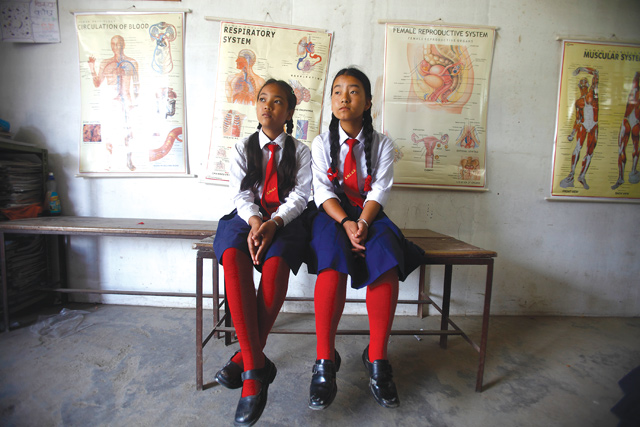
The 11-year-old fourth-grader had heard whispers about “that time of the month” from female family members, but had not expected it so soon and did not really know what to do. For the next 11 days she was confined to a room and was not allowed to look at male family members or perform any of the Dasain rituals. At school she was one of the first in her class to have her period, so she did not have any friends to ask about it. Her textbooks had no answers either.
Renu was in Grade 5 when she got her first period when she was 11, and was ill in bed when it started. “I thought there was something terribly wrong with me, I went to the bathroom and cried my eyes out,” she recalls.
Now 23 years old, Renu says her mother comforted her and told her what was happening. “I had heard about it before, but I didn’t think it would happen so soon,” she says. “If someone had told me exactly what to expect, it wouldn’t have been so traumatic.”
Notwithstanding taboos about talking openly about it and stigmatisation of girls reaching puberty, and the superstitions that lead to the ostracisation of young women, more and more girls in Nepal are getting their first period at an increasingly younger age. Neither families or society, nor the school system is prepared for this change.
“I have seen girls as young as nine start menstruating,” says Kathmandu-based gynaecologist Kundu Yangzom. A study in western Nepal six years ago found the average age of menarche among those surveyed to be about 12.8 years, while their mothers got their first periods when they were nearly 14.8 years old. The study also found girls in private schools, and those with more siblings, are reaching puberty earlier.
Precocious puberty is a worldwide problem, which scientists think may be caused by obesity in young girls, the spread of chemicals called endocrine disruptors found in pesticides and other chemicals in the foodchain, and even the stress induced in young daughters by broken families.
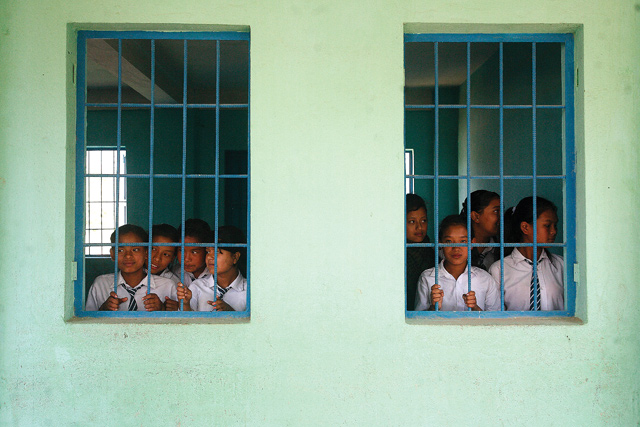
In Nepal, the decreasing age of menarche has exacerbated existing social problems. Because of cultural and social taboos associated with menstruation, girls are often caught off-guard when they have their periods for the first time. In most families, it is not a subject that is discussed openly, and in school the topic does not come up in the curriculum until Grade 6. “By the time the word menstruation was mentioned in our textbook, many of my friends and I had been having our periods for two years,” recalls Suprina, who is now in Grade 7 at Champidevi Higher Secondary School. “Even the textbook wasn’t of much help, it didn’t have any explanation.”