
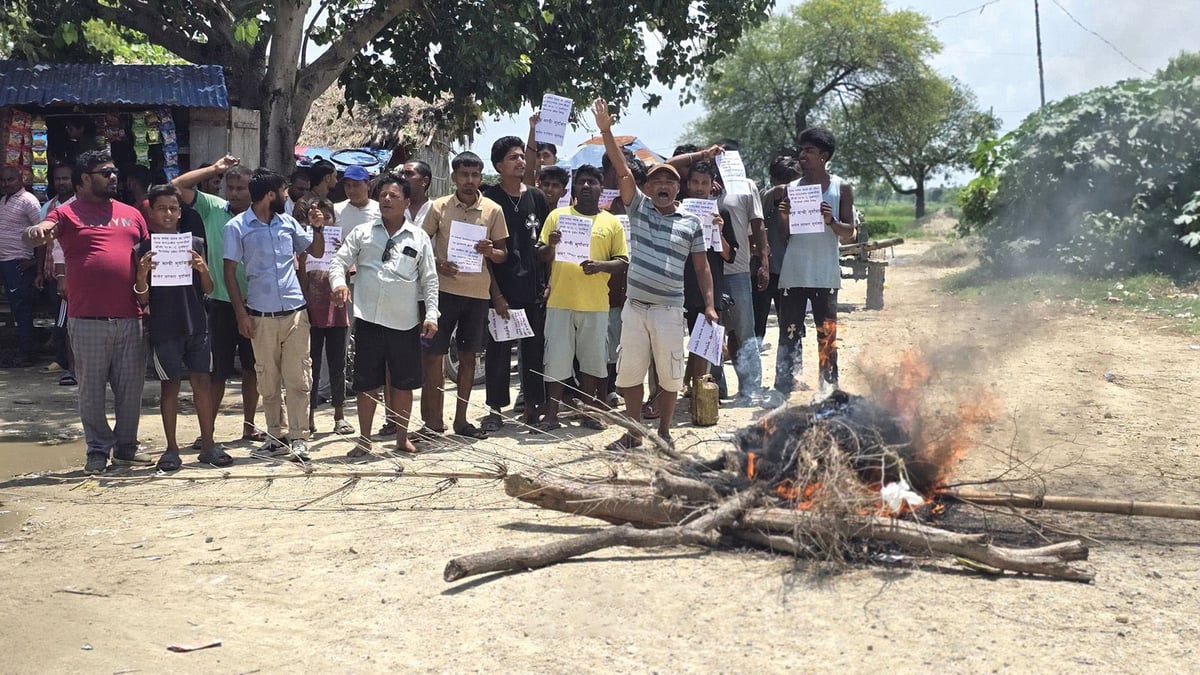
Eleven years ago, the struggle in the Madhes for autonomy and inclusion under a new federal Constitution cost 45 lives. On 26 July, a street dispute in a town near the Indian border in Sunsari sparked sectarian violence across the region.
The irony was that the initial clashes were between Hindu and Muslim groups, but the Armed Police Force and Nepal Police fired live rounds at protestors, ultimately killing three in Sunsari.
Sunsari’s Kaptanganj town had been tense after a dispute over a Muslim banner on an electric pole being replaced with a Hindu one. Both groups taunted each other as a religious procession passed the Muslim neighbourhood. Police opened fire to quell the rioters.
As news of the two deaths in Kaptanganj spread, Hindu groups protested across the towns of eastern Tarai. In Siraha’s Golbazar, police shot and killed 15-year-old Ganesh Yadav on 30 July.
Nepal’s towns along the plains bordering India have seen deadly communal clashes in the past. But the situation has become more volatile because of the influence of political Hindutva from across the border. In some places, far-right ideology is mixed up with pro-monarchist demands and the unfulfilled promise of devolution under the 2015 federal Constitution. Joblessness and political neglect by Kathmandu add fuel to the fire.
The end result is that a region that fought against socio-political exclusion, and won the demarcation of a Madhes Province in the Constitution, is now the epicentre of communal strife.
With the open border and close kinship ties with India, the Madhes reflects India’s socio-political and cultural realignment under Prime Minister Narendra Modi, which has witnessed the mainstreaming of political Hindutva. Indian outfits like the Rastriya Swayamsevak Sangh (RSS) and the Vishwa Hindu Parishad, have substantial networks across Nepal.
The anti-minority rhetoric is amplified on social media, helping it spread across the virtual border. Saffron-clad Hindutva demonstrators in Nepal have been emulating tactics used across the border to taunt and threaten minority groups.
Part of the reason the frustration erupted is also that Kathmandu has kept a firm grip on power and resources despite promises of devolution. Madhes-based parties that misruled the Province were all but wiped out in the March election. This political void is now being filled by anti-secularists, far-right religious groups, and supporters of a Hindu monarchy.
Prime Minister Balendra Shah is of Madhesi origin, and some had hoped that he was a closet monarchist, against secularism and federalism. But last week in a meeting with Madhesi leaders in Kathmandu, he dashed any hope that he supported the restoration of a Hindu monarchy or the scrapping of federalism.
While the New Delhi establishment does not seem to be interested in Nepal restoring its monarchy, Uttar Pradesh’s influential Chief Minister Yogi Adityanath has thrown his weight behind Nepal’s erstwhile monarchy because of his temple’s history of being the patron deity of the Shah dynasty.
Despite Prime Minister Shah’s unequivocal stance, however, a memorandum received by Home Minister Sudan Gurung from the Joint Hindu Front in Janakpur — which includes a demand for an all-party discussion within three months on reestablishing a Hindu state — became the subject of controversy.
Amid questions about whether Gurung had the authority to sign off on such a decision, officials said he was only trying to defuse the volatile situation in the Tarai, and had not agreed to any of the demands.
Many grassroots groups believe that secularism has eroded Nepal’s Hindu identity, but the sociopolitical reality is that secularism has not really been translated into practice. Nepal’s political and state apparatus is still primarily occupied by dominant caste groups.
NEGLECTED MADHES
The Madhes' sectarian flashpoints occur against a backdrop of the region’s unfulfilled aspirations. Madhes has historically underperformed across socioeconomic and human development indicators — 22% of its population still lives below the poverty line, and the province has the highest unemployment rate and the highest volume of international and foreign labour outmigration.
At 63.5%, the Madhes has the lowest literacy rate in Nepal. Despite the region’s contribution to national agricultural production, 43% of farming families have insufficient food to last them a year.
And despite its push for the federal system, weak implementation by an ineffectual regional leadership mired in identity politics, fragmented alliances, and defined by revolving coalitions has failed the region.
In this vacuum of leadership has festered a collective disillusionment and search for other forms of community. This has turned Madhes into a powder keg that is set off by localised disputes along religious lines that spreads across the region.
And the responsibility to handle such disputes is given to a law enforcement that is all too happy to shoot first and ask questions later — an institution that has yet to internalise its operational shortcomings after killing more than 70 Nepalis last September, and of the deaths in the 2015 Madhes movement.
This past week has been the greatest test Prime Minister Shah has faced in the four months since he assumed office. He was slow to rise to the occasion, but when he did with his Facebook address, it did help calm things down. He also dispatched RSP’s MPs from the Madhes to reassure their constituents.
RSP chair Rabi Lamichhane seemed to have a better grasp of the gravity of the situation, and held cross-party and inter-faith meetings to defuse the tension in the Tarai.
For Prime Minister Shah, this crisis serves as a lesson to communicate more with citizens, abandon divide-and-rule and threatening tactics — and not just when there is a crisis. The Madhes violence was a warning that Nepal's socio-economics is tinder dry, and all it needs is a spark.
Shristi Karki