
%20(1)%20(1).jpg)
* The West needs to decolonise and not find legal loopholes to keep stolen sacred objects in their museums
* Repatriation does not give an artefact value and dignity in a land that does not care about its heritage
These opposing views about the resturn of stolen antiquities dominated the discussion that kicked off the exhibition ‘What Empire Took, What Empire Left’ at Taragaon Next last week.
The narrative around looted art has been shaped by the very museums that hold the looted objects. This exhibition flips that script, by listening to 11 artists and thinkers from South Asia who live the reality of those absences.
“It is a great opportunity to speak from within South Asia,” says the expo’s Mumbai-based curator Arshiya Mansoor. “Most of the time, international and Western museums tell our stories.”
Walking through the gallery, the viewer confronts not just stolen objects, but also the stolen context, identity, and heritage. The invisible thread that connects an artefact to its homeland and its people is what gives it meaning. When that thread is cut, the connection is also lost.
But in her opening remarks, Mansoor asked the hidden question behind restitution: “What can return restore?”
Nepali youth, for example, have grown up with empty shrines and missing sacred objects. Many are therefore oblivious to their stories and value. So, can repatriation restore an artefact’s meaning, context, and dignity in a land that is forgetting its heritage? This exhibition, which is on till 31 October, seeks answers.
Roshan Mishra’s ‘Disappearing Devatas and Fading Faith’ deliberates on this directly. This etching on fibre glass and stone of Siva Parvati and Standing Buddha reminds the audience of two sacred idols that are no longer in Nepal: the Siva Parvati figure is currently in the British Museum and the Standing Buddha has not yet been found after being stolen.
“It is not just a physical loss,” says Mishra. “The relationship between the community and the Devi and Devata is lost.”
Cutting a people’s connection to their heritage is itself a triumph of colonialism. Western museums need to not only repatriate the stolen objects, but also acknowledge the need to decolonise their minds, and the societies from where they were stolen need to value them again.
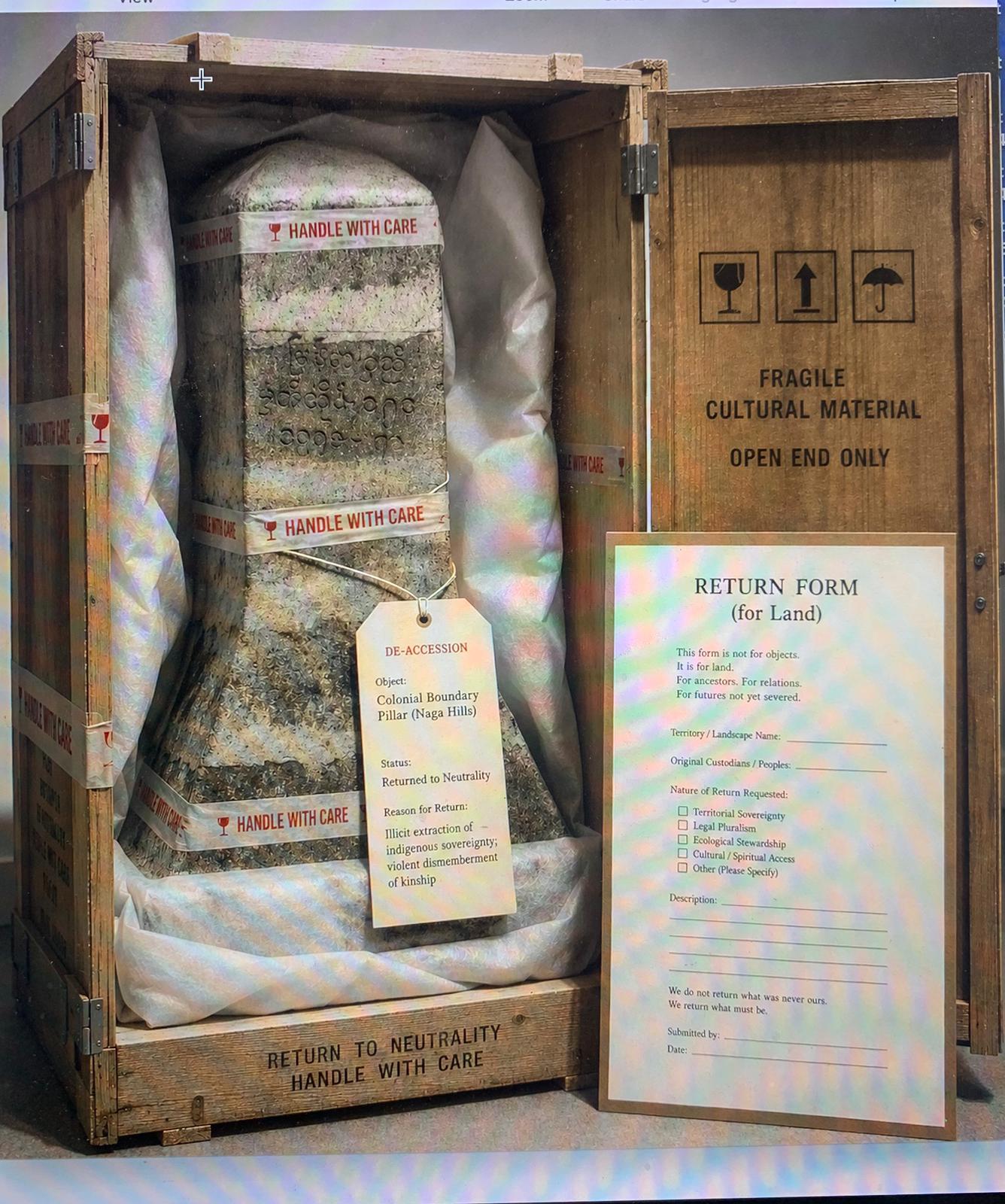
Temsuyanger Longkumer’s ‘Fake Totem No. 32’ is the replica of a boundary pillar between India and Burma which still separates the Naga people living on both sides. This piece transcends colonialism to address what it leaves behind: lines on the map that fracture and divide people, and the absence of belonging that repatriation alone cannot repair.
Marium Ghani documents looted relics and artefacts from the Soviet occupation of her native Afghanistan in a series of prints. The images in ‘Limbo’ depict the pre-Islamic relics that were stolen from Kabul during the civil war. Though identified as stolen, these items cannot be returned because the international community does not recognise the Taliban as a ‘legitimate authority’.
RETURNED, NOT RETURNED
Artefacts are therefore stuck in geopolitical limbo. The irony is that these stolen objects are denied return, while citizens of those same countries are refused protected status and deported back.
Shaurya Kumar’s hand-woven wool tapestry, laid out like a checkerboard mimics the game in Mahabharat in which Draupadi was publicly humiliated. He draws the connection between that indignity to the Princess and the exploitation of stolen artefacts in foreign lands through a dozen 3D-printed sculptures across the board.
Its title ‘It’s Mine; No It’s Mine; Now It’s Yours; No It’s Ours; Yes It’s Missing’ sounds like an argument, but reflects a geopolitical reality. Moving from juvenile possessiveness to shared claim, and finally to loss, the title mimics the constant struggle between ownership of artefacts as well as history.
Kumar draws on his own experience of migration to ask, “How do you start to think about an object when it is not visible?” His digital photographs of a Yogini Temple in India – originally dedicated to 64 goddesses, out of which only 36 have been partially reconstructed – reflect the absence of a piece from its home.
Divya Mehra’s floor-to-ceiling photo mural of stolen South Asian artefacts, ‘Returnism’, takes its name from former British Prime Minister David Cameron’s blunt reply when asked about returning the Kohinoor diamond: “They’re not having it.” He dismissed the request as “returnism”.
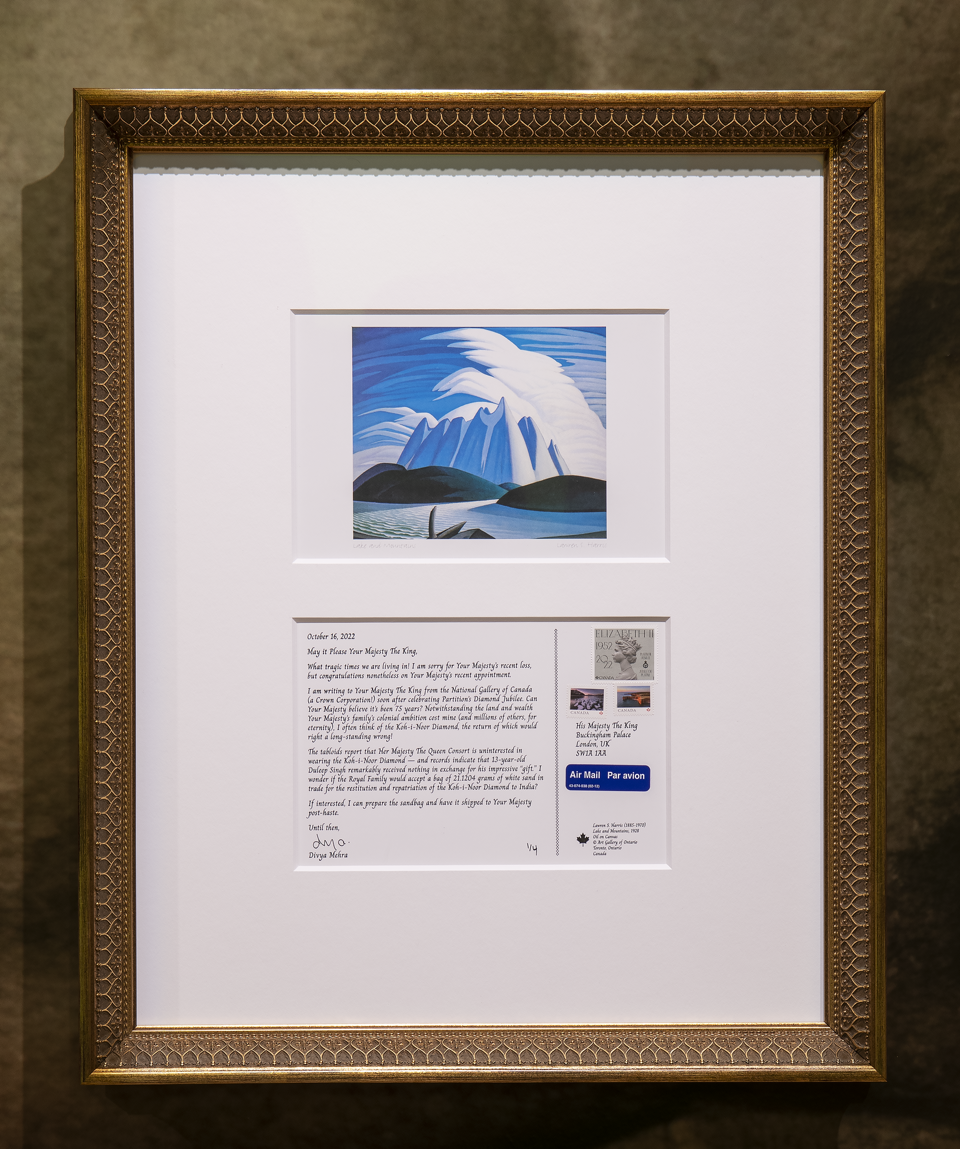
The artefacts in the mural are not grand, they are simply inside a box, open for the viewers to watch. But this choice portrays a larger tragedy: the items are stripped of their context, meaning, identity. In doing so, Mehra rejects the performative display of these artefacts by Western museums.
She had helped repatriate the carving ‘Annapurna’ back to India in 2020 after she found it misrepresented as Vishnu in the MacKenzie Art Gallery in Canada since being stolen in 1913 from Banaras. The mural is a counterpoint to that success. It depicts the artefacts that are yet to be returned, each one echoing Cameron’s refusal.
“Restitution cannot be treated as a museum generosity,” said curator Arshiya Mansoor. “The burden of proof lies not with the colonised nation that asks for its heritage back, but with institutions that keep it without consent.”
“Return is not the end; it is where responsibility begins,” she added. “This exhibition is not nostalgia. It challenges the next generation to understand that repair does not end with the return. It begins when the object comes home after decades and still finds belonging.”
What Empire Took, What Empire Left
Taragaon Next, Boudha
Until 31 October