
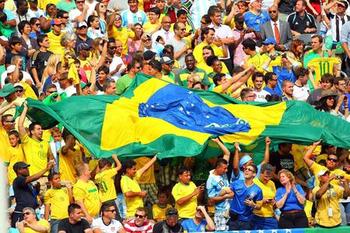
Just 45 minutes apart by flight, no two cities can be as different as Rio and Sao Paulo. Rio is all sun and sand. Sao Paulo is all grey concrete and incessant drizzle. Before the first game of the month long tournament, as Sao Paulo was slowly getting into the futebol mood, Rio had already painted itself in green and yellow – the Brazilian colours – and samba was playing on all street corners. A week before the opening game, all bars and cafes were adorned with the Brazilian flags, a lot of streets had been painted with “Hexa Copa” (Get us the sixth cup) slogan, banners and flags were hanging from building windows and the Brazilian team jerseys were on sale on kiosks set up on streets. “The world cup has come and gone but the football is going to stay with us. We are celebrating football. It doesn’t matter who wins. Of course, if it’s Brazil, we will have tremendous joy,” says 54-year-old Joao Mendonca, sipping a beer with his buddies at a bar in the Flamengo area.
Football brings pleasure to people in Rio. Here they compose samba songs at the time of the world cup. As the players dribble the ball on the pitch, people dance on the sidewalks. As the goals are scores, they beat their drums with joy. When a game ends, they laugh and cry at the same time. “It’s not the ball that’s at the feet of players. It’s our heart which they kick from side to side,” says Mendonca, breaking into a smile.
Like any other sport, football has two sides. One is the action that takes place in the arenas: moves made, ball dribbled, goals scored, dreams fulfilled and heats broken. But there is action far from the stadiums: people watching games in bars, dancing on the streets, crying on the sidewalk and just sharing the triumphs and failures with friends and families in the comforts of their living rooms or warmth of a bars.
Last Saturday, more than 1,000 Argentines closed for the Avenida Atlantica at Copacabana Beach in Rio de Janeiro as they organised an open-air party, one day before their team’s opening game against Bosnia at the Maracana stadium. The Argentinians were in such fun mood that they even had a lookalike of Pope Francis, who is Argentine, as part of the celebrations. The “Pope”’ was carrying a replica of the world cup in his hands. There were more than 35,000 Argentinians in the city. Most of them watched the game at the Maracana. And after the Messi-led team wins, there was one hell of party on Rio streets.
And on Wednesday night, the Chileans painted the city red as their team beat Spain 2-0 at the Maracanã, graveyard of great expectations. This world and double European champions became the first team to leave the 2014 World Cup, knocked out of a major tournament for the first time in eight years.
Read also:
The beautiful mirage Marcela Mora y Araujo
When football comes home Shobhan Saxena
In goal we trust Shobhan Saxena
Brazil's own goals Matt Slaughter and Janna Remes
Performance Art Matt Miller