
 Pic: Bikram Rai
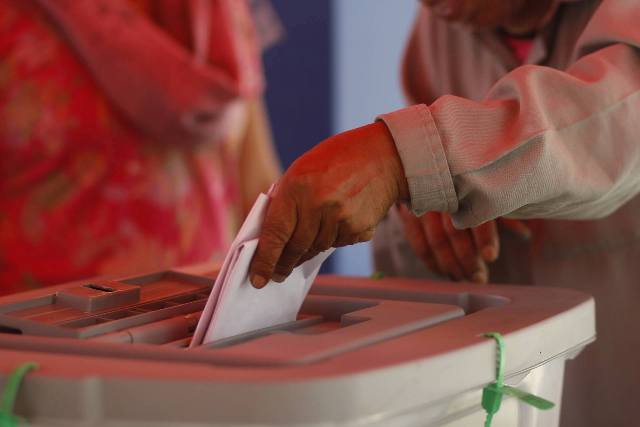
By all accounts, the first round of local elections on Sunday went off much better than anyone had expected, with people voting enthusiastically and in large numbers for their local ward, village and municipality members. However, the Election Commission's decision to count ballots and declare results immediately has raised concerns
about the second phase next month.
Even so, the orderly voting and high turnout on Sunday has raised hopes that despite delays caused by a deadlock in the constitution, this could be a landmark on the road to greater inclusion and political devolution.
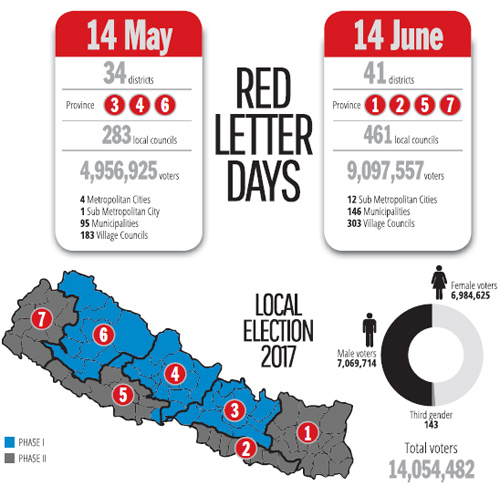
Nepal's first local elections after 19 years are being held in two phases, with the hope that Tarai-centric parties will also participate in the second round on 14 June. Voting in the second round in four provinces bordering India will be much more challenging also because there are twice as many voters, and the winners and losers of the first round
could try to influence the second phase.
The first round was held only in 34 districts of three provinces, and the second round will be held in 41 districts of four provinces. And the number of voters for the second round will be nearly 10 million.
But these are purely logistic challenges, and the Election Commission (EC) – which has the experience of successfully holding two Constituent Assembly (CA) elections in the last decade – is certainly up to meeting them. However, the EC needs to be supported by the political parties, whose success or failure to amend the Constitution is a key to the second round of polls.
Tarai-centric parties (except Upendra Yadav's Federal Socialist Forum Nepal that is transforming itself into a national rather than a regional party) did not take part in Sunday’s local elections. They have promised to take part in the second round, but the Maoist-NC coalition first needs to amend the constitution to their satisfaction.