

Three weeks ago I wrote a column about people increasingly sharing photographs of their relief efforts on social media and doing so to seek validation and in an effort to be “mini-celebrities”.
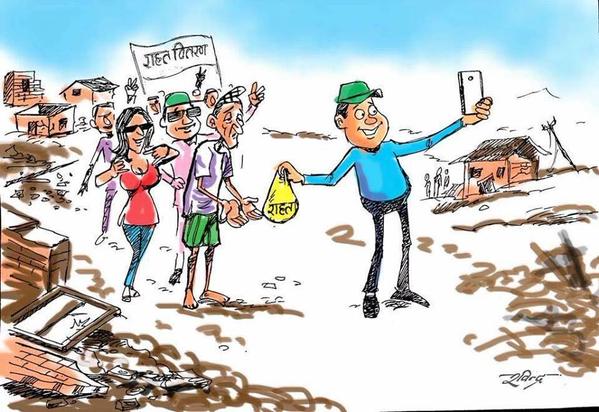 Cartoon by Rabindra Manandhar illustrating the distributing relief selfies
A lot of you didn’t agree with it.
Many readers wrote back saying displaying helpful acts was their way of encouraging more people to join in and to prove to others that they were doing their work on ground. It was also suggested that my view was somehow dissuading people from helping.
The issue here is whether true altruism exists. American journalist and author Andrew Tobias doesn't think so.
Studies have shown that any form of charitable act increases the level of the hormone oxytocin in people. Oxytocin is the 'feel good' hormone that is also called the love, hugging or holiday hormone: as it tends to be produced more when someone is helping others.
Helping others also triggers other feel good chemicals such as dopamine and endorphins.
"I believe we should help those in need because someday I may need help too. The universe balances everything," said Jovan Paunovic, venture capitalist and serial entrepreneur from Serbia, who supported Nepal during the earthquake without making it a big post on social media, till now. "But does altruism really exist? I guess it’s a philosophical discussion."
The definition of altruism is the belief in or practice of disinterested and selfless concern for the well-being of others (selfless as only for others).
There are many benefits to being altruistic. For one, it promotes the overall well-being of a person: the emotional, mental, physical and spiritual health. Altruistic people live longer lives. It helps build connections and relationships with others as humans are social animals.
Overall, giving to the community or the world is something that does uplift our consciousness. So if we feel good when we help others, does it defeat the whole point of selfless help? We could feel happy and perhaps choose not to plaster it on social media.
Studies also show that when the level of oxytocin goes up, the level of stress comes down: a win-win situation. Oxytocin boosts one's self esteem and confidence, which could be one reason why people think it is acceptable and normal to inform family and friends of their contribution to the community, country and the world.
They say the more oxytocin you have, the more prone you are to giving.
An interesting finding is that a higher level of oxytocin also causes aggression towards competing groups. University of Amsterdam (UvA) says that this hormone causes people to show special treatment towards people in their own group and aggression towards competing groups. Could this be the reason why some people feel the need to help more than their rivals?
Experts say from a classical economic perspective, altruism does not exactly make sense but from an evolutionary point of view it is believed that individuals only exhibit altruistic behaviour to make themselves more effective and stronger with more long-term benefits. Even Darwin suggested that altruistic groups may have a greater chance of survival.
Said Francisco Lopez, Sergeant at United States Marine Corps, who was in Nepal during the 25 April earthquake: "I helped because I have the knowledge and training. It is not something I think about, for me, helping is a natural and subconscious reaction to a need. I didn’t think to tell anyone what I did."
Anjana Rajbhandary @AnjyRajy