

 From the Nepali press
Mahesh Acharya in BBC Nepali, 24 April
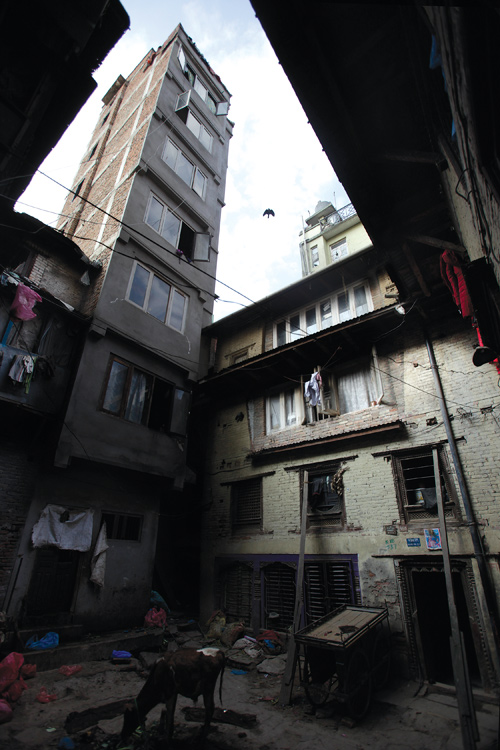
Two years ago, when the earthquake destroyed the mud-mortar houses in Kathmandu Valley, it convinced many that cement buildings were safer. But a new study has revealed that many of the reinforced concrete construction (RCC) buildings in the Kathmandu Valley do not follow meet the minimum government standards and would not withstand a strong earthquake in future.
The two year-long study titled ‘Project for Assessment of Earthquake Disaster Risk for the Kathmandu Valley’ led by the Ministry of Urban Development in coordination with Japan International Cooperation Agency (JICA) and other government agencies found that out of 250,000 RCC houses in Kathmandu only 27,000 or so followed proper
engineering and design guidelines.
“Only six per cent of the RCC houses in Kathmandu Valley follow engineer approved designs, whereas 48 per cent houses are non- engineer RCC building meaning they were constructed by the house owners without keeping the earthquake safety in mind,” explained Suman Salike, senior divisional engineer at Ministry of Urban Development who was involved in the assessment.
According to the 1993 building code, an RCC building needs to have 12x12 inch pillars, but engineers involved in the assessment said that many of the RCC houses were found to have 9x9 or 9x12 inch columns.

“There are criteria for load calculation in the building code, and the building code at the time deemed that a 12x12 inch column would sustain the load of a building with a certain number of floors,” said Ram Bahadur Thapa of head of construction permit division at Kathmandu Metropolitan City. This rule is applicable to buildings of up to three
stories having less than 1,000 sq ft foot print. Today, most concrete buildings in Kathmandu are more than three floors and need pillars and beams that are stronger, with bigger dimensions and more rods.
Experts also said that the building codes need to be followed more strictly and amended accordingly to build safer and stronger houses. “If you don’t upgrade this building code, you will have to suffer damage equal to or more than in 2015. That is why it needs to be amended,” said Riyochi Takahashi of JICA who was involved in the assessment.
Along with study, the government has also started discussions with national and international experts to amend the criteria in the building code so it reflects the requirements of taller buildings and stronger earthquakes. There are around 450,000 houses in Kathmandu Valley, half of them are of RCC and most do not meet the specifications in the
building code.
Listen to full report in Nepali.
Read Also:
Building back unsafe, Om Astha Rai
Search, locate, rescue in collapsed concrete houses,Sonia Awale