

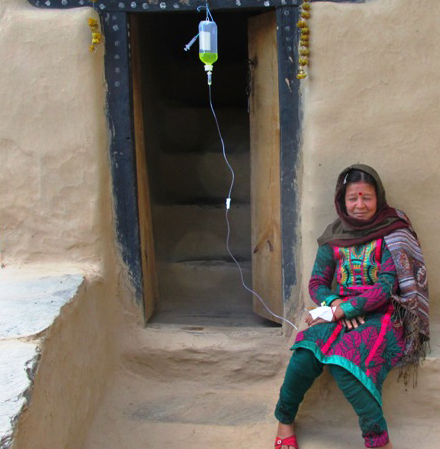
 A patient suffering from the flu-like disease receiving treatment at her own house in Paink VDC of Jajarkot district . Photo by Rajendra Karki
RAJENDRA KARKI in Jajarkot
Villagers of the worst affected areas of these mid-western mountains of Nepal are suffering a double neglect by the state: it was state negligence that led to the deadly swine flu epidemic that has so far killed 25 people, but it is also government neglect that means more people are going to die.
The villagers say the government response has been too late and too little to battle the epidemic of the flu-like disease that has raged through the countryside. Some of the patients have tested positive for swine flu, but health experts say it is likely that a combination of malnutrition, gastric infections and flu that killed many of the victims.
"We alerted local health officers about a possible outbreak right after the first death," says Rabindara Shahi, a 28-year-old resident of Archhane village, “but there was no sense of urgency.”
Archhane is the first village to be affected by the outbreak. Sushmita Joshi, 20, had complained of high fever and flu after returning from a SLC examcentre. She died a few days later.
Shahi says the initial infections were brought to Jajarkot by seasonal migrant workers returning from India to celebrate Chaite Dashain. "During the SLC exams, they gathered around schools to help their children," he says. "It was probably how swine flu spread to the local people."
Over the next couple of weeks, the flu epidemic spread to other villages like Paink, Talegaun, Pajaru, Sakala and Nayakwada killing more people. In two different tests conducted by National Public Health Laboratory, eight of the 18 samples tested positive for H1N1 influenza, commonly known as swine flu.
Dhir Jung Shah Chief of District Public Health Office of Jajarkot, however, says that only six of the fatalities were caused by swine flu. After swine flu was confirmed, the government deployed more health workers to Jajarkot. While a few health teams have already returned to Kathmandu, at least four health teams, two sent by the Nepal Army, are still there.
But the population affected by swine flu is so large and so widely scattered that it is impossible for the health teams to attend to all the patients. And there is a lack of medicines like tamiflu that is given to flu patients.
Pemba Dorje Lama, who is in charge of a sub health post in the disease-hit Talegaun village, "We don’t have single tamiflu tablet."
As the government fails to provide adequate medical staff and medicines, discontent against the state's apathy is growing among the Jajarkot people. "The state has always neglected us," says Janak Singh, a 38-year-old resident of Talegaun VDC-1. "We are left alone to die even this time."
Janak's 66-year-old aunt Maheswori Singh died of flu and fever last week. "A health team arrived in our village only after my aunt's death," he says. "Had health workers responded to our plight, she would not have died."
Jajarkot folks are not only angry with the government but also with NGOs that have showed indifference to their plight. Several NGOs have instructed their Jajarkot-based staff to avoid visiting the flu-affected villages. A few of them have even recalled their staff from the flu-affected villages.
Keshav Jung Shah, Chair of Jajarkot Civil Society, said the epidemic exposed hypocrisy of social workers. "Those who claim to be working for the poor and needy showed their true character," he said.
After the swine flu outbreak, almost all government offices and NGOs have made it mandatory for every one put on mask while working. "We have also asked service seekers to put on mask," said Ananda Karki, an assistant manager at Nepal Bank Limited, Jajarkot.
A cholera epidemic in Jajarkot four years ago killed at least 300 people, most of them children.