
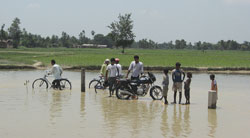
 Pic: Dipak Rauniyar
From the Nepali Press
Kalendra Sejuwal in Nagarik, 3 July
When India wanted to build the Kalkalwa Embankment in 1985, the local council of Holiya Village of Banke district, fearing submergence on the Nepal side of the border called on Kathmandu to take matters up with New Delhi. After negotiations between the two governments, the project was stopped.
Fifteen years later when the embankments started to be rebuilt the villagers knocked on the government's door again. However, this time Kathmandu couldn't be bothered. Between 1999 and 2000 the Indian side built a 22 km-long embankment to save the villages on its side from floods, disguising them as new roads.
"Even though India constructed the infrastructures against the international law and treaties between the two countries, the protest has only been from the local level. The Nepal government has never addressed the issues at the diplomatic level," says Jagdish Bahadur Singh of a local committee formed to protest the construction of the embankment.
Singh says India has gone ahead with a plan to save its territory from being submerged by shifting the floods on the Rapti River to the Nepal side, and using its water for irrigation in the dry season. Six years ago, India started constructing a 1,750 km road along the India-Nepal border, citing security reasons, but in reality the roads are embankments to preventing flooding of Indian territory, and act as a gigantic dam that impounds water on the Nepal side.
'India's objective behind building the infrastructures along no-man's land is to save its villages from being flooded and the erosion of land caused by Rapati river,' reads the memorandum submitted by the committee to the Banke District Administration Office, 'steps should be taken to halt the construction of the road.'
Since the Kalkalwa Afflux Bund was constructed in 2000, villages in Nepal including Holiya, Bethani, Bankatti, Fattehpur and Gangapur have been flooded every monsoon, submerging farmlands and affecting 25,000 people.
In 2003, during Girija Prasad Koirala's visit to India, an agreement was reached to open the sluice gates in the embankments so that the Nepal side would not be flooded, construct a levee to stop erosion on both sides, and compensate victims. The agreement was never implemented.
"If there are more sluice gates and outlets it would reduce the damage caused by the dam. But for this the government needs to hold talks with the Indian side," says Binod Chapagain of People's Embankment Program, Nepalgाnj.
When local MP Dinesh Chandra Yadav requested the government to intervene with India before the construction of the road began, no one did anything. The local administration inspected the area and sent a report to the government only after construction began.
In 2015, during a secretarial level meeting between the two countries, the then-Chief District Officer of Banke Ved Prasad Lekhak presented the road as a point of discussion. The two sides agreed to form a technical team and work to solve problems based on their research report. The Nepali side failed to move ahead with the plan, but India has also time and again agreed to work to reduce the impact of Kalkalwa and Laxmanpur Levees.
When the Nepal-India Joint Committee on Inundation and Flood Management and a technical team from Nepal surveyed the area, India was ready to construct a 28 km-long embankment on the Rapti River but Nepal did nothing. According to Bhel Nanda Yadav, the then-chief of the Water Induced Disaster Prevention office, a report to build a 5 km road was ready, but it was never built.