
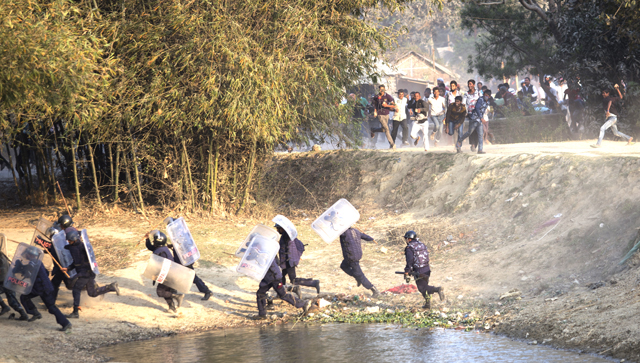
 Pic: Shrawan Kumar Deo
From the Nepali Press
Rameshwar Bohara in Himal Khabarpatrika, 12-18 March
In August 2015, after four people were killed in violent clashes, police constables were allowed to carry only batons and tear gas. Guns were given to junior officers, but with a clear instruction not to use them unless as a last resort.
Five days later, eight policemen including SSP Laxman Neupane were lynched in Tikapur of Kailali in the far-western plains. One child was shot dead by protesters.
After the Tikapur tragedy, policemen were so terrified that they began opening fire whenever they felt threatened, often shooting people in the chest and head. Over 50 people were killed in the ensuing violence of the Madhes movement that lasted five months.
The deaths last week of five people in police firing in Melath of Saptari showed that police are still scared of being lynched and panic when there is a mob throwing stones. Lack of training in crowd control and resources also means they keep repeating the same mistakes as in 2015.
Human Rights Commissioner Prakash Wasti, who has observed and analysed recent killings in the Tarai, says policemen lack the confidence and morale to control riots, and feel threatened by protesters. "This is why police open fire even when the use of gun is not needed," he says.
After the Tikapur lynchings of its personnel, the Nepal Police sought non-lethal weapons worth Rs 3 billion: 22 water cannon, 22 riot control vehicles, 1,000 electric shock guns, 1,000 multi gas guns, 5,000 pepper sprays and Rs 20,000 bamboo batons.
"But the government did not give us anything," a senior police officer says. "If we had enough non-lethal equipment, we could have controlled the crowd without killing anyone in Saptari."