
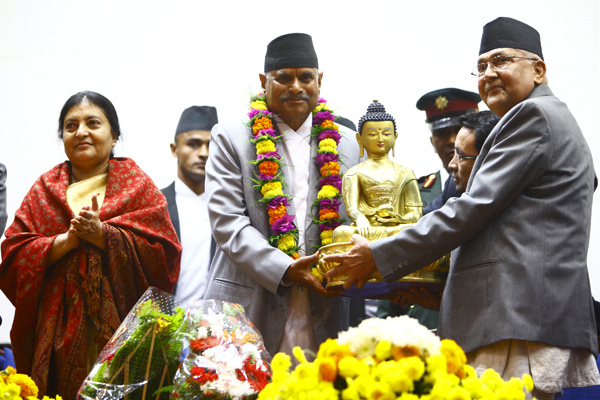
 Prime Minister KP Oli bids farewell to ex-President Ram Baran Yadav in presence of President Bidya Bhandari during a special ceremony in Shital Niwas on Thursday. Photo: Gopen Rai
Nepal's first President Ram Baran Yadav quietly left Shital Niwas on a rainy Thursday in Kathmandu, vacating the Rana era royal bungalow for the country's first woman head of state, Bidya Bhandari.
Just like Bhandari's victory on Wednesday in the parliament election for president symbolised a paradigm shift in a deeply patriarchal state like Nepal, Yadav's election in 2009 signaled the beginning of an end to the age-old dominance of Kathmandu’s traditional rulers.
Timeline by Ayesha Shakya
On 23 July that year, all major political parties except the Maoists voted for the NC's presidential candidate Yadav and a self-made Madhesi medical doctor from the eastern plains district of Dhanusa. Yadav became the face of a secular republic that was a Hindu monarchy until then.
Like Bhandari, Yadav became President not just on merit but because of a combination of luck and changing political circumstances.
Within the NC, there were far more senior, and capable, leaders than Yadav. Girija Prasad Koirala was himself an aspirant to replace King Gyanendra as the Head of the State. But Maoist Chair Pushpa Kamal Dahal did not followup on his promise to Koirala, and the commander of the 2006 Democracy Movement zeroed in on Yadav as a presidential candidate.
Veteran leader Mahant Thakur had quit the NC to form his own Madhes-based regional party, making Yadav an undisputed presidential candidate. The two recent Madhes movements, Thakur's exit and growing clamour for mainstreaming of Madhesis turned out to be the luck factor in Yadav's path to Shital Niwas. His victory in Nepal's first presidential election once again proved that luck is all about being in the right place at the right time.
A buffalo herder from Sapahi village of Dhanusa, Yadav had never dreamed about entering politics, let alone becoming Nepal's first President while in medical school in Kolakata. But he was politically conscious even in Kolkata, becoming close to democracy campaigners like BP Koirala and Ganesh Man Singh. Growing closeness with Nepali leaders in exile prepared him to champion the cause of democracy.