
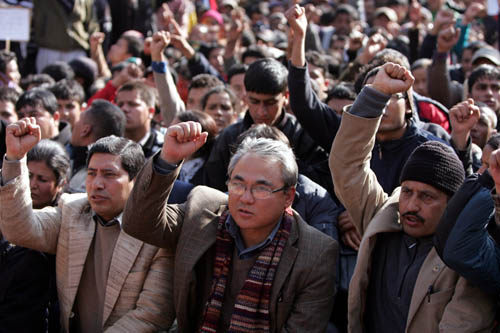
Indian Army Chief Deepak Kapoor arrived in Kathmandu on Tuesday for an official visit, during which he will be awarded the title of Honorary General of Nepal Army. It is a 60-year-old tradition practised by the two countries, but Kapoor is the first Indian general visit Nepal in eight years as his predecessor declined to visit Nepal during the Maoist insurgency citing security reasons.
His visit is not without controversy. On Monday, the Maoists boycotted the parliament saying the government had failed to respond to Kapoor’s remarks opposing bulk integration of Maoist combatants in Nepal Army. From The Kathmandu Post:
A day before Indian Army Chief Gen. Deepak Kapoor’s four-day “goodwill visit”, the main opposition UCPN (Maoist) boycotted Monday’s Legislature-Parliament session demanding that the government clarify its position on Kapoor’s views opposing bulk integration of Maoist combatants into Nepal Army last month.
Maoist claim Kapoor made the remark during Nepal Army Chief of Staff Chhatra Man Singh Gurung’s visit to India. It has been one of the issues driving their campaign for “national independence”. India has said media reports ‘distorted’ Kapoor’s remarks. The Kathmandu Post writes:
New Delhi issued a statement on Jan. 4 saying that media reports attributing “certain remarks” to the Indian Army chief on the issue of PLS integration were “highly distorted” and they didn’t reflect the government of India’s position on the issue.
Maoist boycott forced Prime Minister Madhav Kumar Nepal to make a 'hasty retreat' from the parliament on Monday where he was expected to clarify his statement to deal with the Maoists in the same way Sri Lanka dealt with Tamil Tiger rebels. The Himalayan Times reports:
The PM had reached the Constituent Assembly Hall to address the House on the Maoists’ concerns but returned without addressing the meeting after the Maoist lawmakers threatened to boycott the parliament if his reply were not satisfactory.
Some progress was made in the political arena despite the ducking and running. The Special Committee on Supervision, Integration and Rehabilitation of Maoist combatants reached an agreement on the code of conduct for People’s Liberation Army soldiers stationed in various cantonments. The agreement, which had been floundering since September due to Maoist opposition, bars PLA fighters from engaging in political activities. Republica reports:
Under the code, combatants will have to stop singing the international communist song in the cantonments as they have been doing everyday. It also requires the PLA to remove the pictures of national and international communist leaders including Pushpa Kamal Dahal, Marx and Lenin, and their communist flags. It also requires combatants to erase communist slogans, including that of Dahal, painted inside the cantonments. They will have to stop saluting their leaders in the communist style once the code comes into effect, said the members.
The new code will also prevent Maoist leaders from giving speeches inside PLA cantonments. Leaders will be free to blow off steam outside the cantonments as Maoist Chairman Pushpa Kamal Dahal did in western Nepal on Monday by saying Nepal should claim territories extending from Tista in the east and Kaganda in the west. Nagarik reports:
He said Nepal should terminate all discriminatory treaties with India. He claimed that treaties signed with the British, including Sugauli treaty, are invalid. “Sugauli Treaty was not signed with India or its people, but with the British,” he said. “The treaty is not valid since British rule has ended.” As a result, he said, Nepal can claim territories from Tista to Kaganda.