

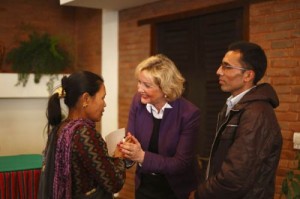
German Parliamentary State Secretary for Development Cooperation Gudrun Kopp spoke to Nepali Times at the end of her three-day visit to Nepal this week.
Nepali Times: Did you get any indication in your meeting with senior Nepali ministers that they really understand or have a commitment towards transitional justice?
Gudrun Kopp: Yes, I did. When I first prepared my trip to Nepal, the priority was different. We intended to look at renewable energy, health, decentralisation empowering local government in the villages to prepare for the bilateral
negotiations on future cooperation between Nepal and Germany in May. But when I read about the state of the peace process, I was really worried. I talked to my experts in the ministry about the proposal to grant general amnesty. Of course, we can't be telling another government what they should and shouldn’t be doing. But we bear our share of responsibility when it comes to the question for whom and what we are going to spend our taxpayers’ money for. We underlined towards the government, the importance of good governance, respect for human rights and justice. The government of Nepal asked for more private investments and therefore I urged the prime minister to first build a conducive economic framework to attract foreign investment. The rule of law is absolutely essential for further economic development.
Is progress on truth and reconciliation and disappearances going to be linked to future aid?
As a friend of Nepal I wish to make it quite clear that progress on the two mentioned commissions and the entire inclusive peace process will be crucial for our forthcoming government negotiations.
Do you think the message went home?
Absolutely.
Are you optimistic that they will act on it?
Personally I had the impression that the prime minister is really willing to act accordingly. I don’t know whether he will be able to bring all parties concerned around the table to find a compromise including representatives of the victims
and actually dealing with the cases. I know it is difficult, but it will be even more difficult not to do so.
Does the relatively more nuanced way Germany deals with these issues is a result of Germany's own history?
Definitely! We as Germans made mistakes in the past and had to suffer from the country's division for more than four decades, families were separated and society broken up. Reunification and sorting out our past – including severe offences - were tough. We know how harmful it is to be a divided nation and therefore would like to share our experiences and lessons learned with others. Denying the past can never help building a bright future. Sweeping
away past injustices will doubtlessly lead to future conflict.
You included Purnimaya Lama and Suman Adhikari in your press conference in Kathmandu. What struck you the most about what they had been through?
Both were calling out for justice – not revenge! We could feel their suffering. How a woman, who has a weaker standing than a man in this society, could keep her strength, perseverance and still has the will to make other feel the injustice she has been suffering was very moving. It is absolutely admirable how powerful she is in a country where a woman's
voice is often so feeble. Suman is not angry with the government, he is not seeking revenge, he is not “carrying a weapon”. Both just want justice. Maybe this reaction is typical for Nepali culture, where deep inside people are peaceful.
Given Nepal's progress in health and education, do you anticipate Germany's aid policy to have a different emphasis?
It will have to be more inclusive. We will have women and children in focus. For example it will be wise to train midwives in villages since many young pregnant women don’t go to hospital and therefore training and sending midwives to village is important and effective. People with disabilities who are still being neglected need special attention, too.
Are there any concrete thoughts what might be the agenda in the May assessment of aid policy?
We will be moving away from further big national energy projects like the Marsyangdi project which cost over 150 million euros. Instead, we will put an emphasis on smaller decentralised projects with biogas and solar that can function independently.
Related story:
German concern on impunity, The Brief, 8 March 2012