

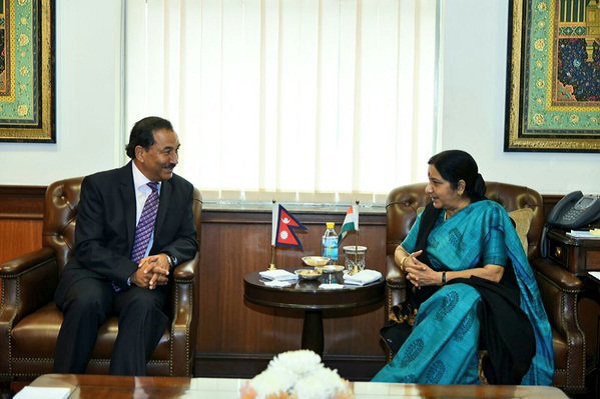
India has once again asked Nepal to find a political solution to the Tarai crisis, which has led to a crippling blockade against the landlocked country still recovering from a devastating earthquake.
In a meeting with Nepal's Deputy Prime Minister and Foreign Affairs Minister Kamal Thapa in Delhi on Wednesday, India's External Affairs Minister Sushma Swaraj reiterated the need for an urgent political solution to problems facing the Himalayan nation.
Swaraj hinted that the blockade will be lifted only when Nepal's political crisis is resolved.
Spokesperson for India's Ministry of External Affairs Minister Vikas Swarup tweeted: "EAM @SushmaSwaraj assures DPM Kamal Thapa that there is no hindrance to supplies from India. But Nepal needs to normalize situation asap."
Thapa said the meeting with Swaraj was 'fruitful' but he has yet not revealed details about it. He tweeted: "Had fruitful and cordial meeting with Indian Minister of External Affairs Ms Sushma Swaraj today in Delhi."
This is the second time after India restricted supplies of essential commodities to Nepal that Thapa met Swaraj. In the third week of October, Thapa had requested Swaraj and then India's Prime Minister Narendra Modi to ease supplies of essential commodities to Nepal.
But Thapa's first Delhi visit did not help ease tension between the two neighbours. Instead, India raised the issues of war crimes committed during the decade-long Maoist insurgency and urged Nepal to allow transitional justice mechanisms to function in a free and fair manner at a UN Human Rights Council in Geneva. It was the first time India blamed Nepal for ignoring war crimes.
Prime Minister KP Oli criticised India for being oblivious of the peace process initiated by Nepal after the end of the war.
Nepal's major border posts with India are blocked by Madhesi protesters since the last week of September, and a humanitarian crisis is unfolding due to shortages of fuel, foods and medicines. UNICEF has recently warned more than three million children, mostly affected by the earthquake and still living in temporary shelters, are at risk of death and diseases due to shortages of essential commodities this winter season.
India has not only allowed Madhesi protesters to stage sit-in on No Man's Land but also restricted supplies through border posts unaffected by protests.
In Kathmandu, top leaders of the ruling coalition and the Madhesi Morcha are trying to reach a deal which India says would be necessary for easing supplies. But possibility of a deal is not very high.