

The quest for justice unites two women whose relatives were killed and disappeared by the Nepal Army and the Maoists
Last Thursday, Purnimaya Lama (pic, right) and Debi Sunwar were among the 20 human rights activists arrested by police from Singha Darbar to protest the amnesty provision in the bill on Truth and Reconciliation Commission (TRC) and Commission of Inquiry on Disappearances (CID) which were tabled in parliament on 9 April.
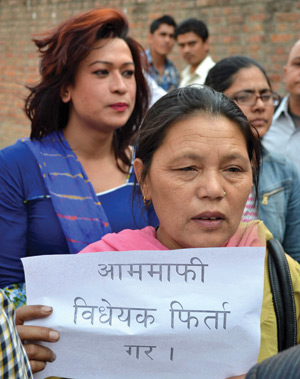 Bikash Karki/Annapurna Post
Sunwar’s daughter Maina was 15 when she was tortured and killed by officers of the Royal Nepal Army in 2004 and Purnimaya’s husband Arjun Lama was abducted by the Maoists in Kavre in 2005 and was never seen since. Since then the two women, like thousands of Nepalis whose lost children, parents, siblings or friends to extra-judicial killings by state security or the Maoists have been
seeking truth and justice.
The NC-UML coalition tabled the bill even though it was weaker on providing justice to the survivors and relatives than the one drafted by the Maoist Bhattarai government two years ago. The three parties agree that conflict era crimes, except the grave ones, should be addressed by the Commissions and not by normal criminal courts.
But both Lama and Sunwar say the bill is unacceptable. “The clause on general amnesty is an insult to the victims and their families who have been fighting so long to see the perpetrators tried and punished for their actions,” Sunwar told us on Wednesday. One of the most vocal activists among relatives of conflict-era victims, Sunuwar filed a complaint at Kavre District Police Office in November 2005, naming alleged perpetrators, including Capt Niranjan Basnet.
It was only after the conflict ended that Maina’s body was finally exhumed in March 2007 from inside the army base. The Kavre District Court has issued orders for the arrest of the four accused in 2008 but they are still free.
Says Sunwar: “We are being treated as second class citizens in our country, our hopes of justice have died now. We will be forced to take things in our hands if this situation continues.”
The bill tabled last week defines rape, torture, custodial killings, forced disappearances, among others as 'grave human rights violations', crimes which merit prosecution. However, it also gives power to the Commissions to grant amnesty, and in such cases closing door for prosecution.The Commission can also drag cases out, citing lack of evidence.
Her quest for justice for her husband's death has taken a toll on Purimaya Lama’s health. She is now 50 but looks older, and is frail. Her father-in-law died a few years ago without ever finding the whereabouts of Arjun Lama, and Purnimaya now worries about her own health.
“My body can’t take all the stress and sometimes I feel all this will drive me insane,” says Purnimaya. Former Maoist ministers Surya Man Dong and Agni Sapkota, have been charged with involvement in Arjun Lama’s abduction. "My husband was not involved in the war, his murderers, instead of being punished became ministers. We are humans, our fight will not end without we get a closure.”
Bhrikuti Rai
Read also