
India, China and Nepal are to cooperate in conserving the Kailash-Mansarovar landscape under the auspices of the Kathmandu-based International Centre for Integrated Mountain Development (ICIMOD).
The 31,000 sq km sanctuary will include 9,000 sq km in India, 10,000 sq km in Nepal and 12,000 sq km in China. The mountain and the lake at its base is not just a major tourist attraction and a habitat for bird and wildlife on the Tibetan plateau, but it is also revered by Hindus, Buddhists, Jains and the animist Bon Po faiths.
Announcing the plan for the trans-boundary sanctuary in the Himalaya, India's Minister for Environment and Forestry, Shri Jairam Ramesh said: "This is an important regional eco-system initiative and will address
the environmental, economic and spiritual aspects of Kailash-Mansarovar and will be similar to other transboundary initiatives like Kangchenjunga and the Tarai Arc landscape."
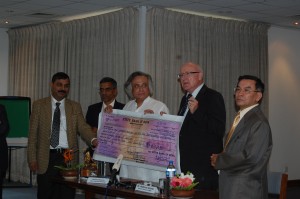
Ramesh was in Kathmandu on a three-day visit to attend a regional conference on climate change in the Himalaya organised by ICIMOD. He said India had decided to be "much more active" in supporting ICIMOD and would take on an "expanded role". He handed over a cheque for $160,000 for this year, and pledged another $200,000 for next year.
Ramesh also said India,as the world's third largest carbon emitter, was fully committed to reducing its footprint and would adopt a low-carbon growth path unilaterally and voluntarily.
He said there was "too much politics and too little science" in the study of Himalayan glaciers, adding that the glaciology of the Himalaya was complex. "Glaciers may be retreating in the east, but they are advancing in the Karokoram," he added.