

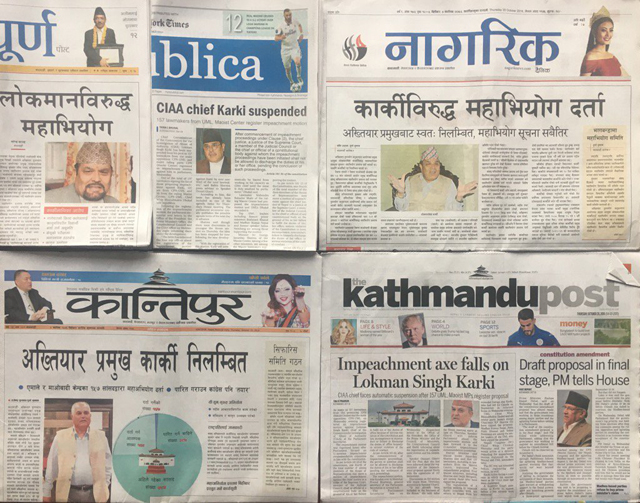
Political developments in Nepal don’t evolve, they happen in fits and starts. And so it was with the leaders of the three main parties coming together Wednesday morning to rush impeachment proceedings against Lokman Singh Karki of the Commission on Investigation of the Abuse of Authority (CIAA). Since his appointment in 2013, the anti-corruption czar had emerged as a political figure more powerful than the prime minister by targeting businessmen, politicians, lawyers, and silencing critics, editors and publishers.
Working swiftly and in top secrecy while Karki himself was en route from Abu Dhabi to Kathmandu after a month-long holiday, the UML and the Maoist Centre got 157 MPs to register the impeachment motion in parliament on Wednesday evening. The top three leaders didn’t suddenly get pangs of conscience and act to save democracy, they had received information that Karki was preparing to file court cases against dozens of top politicians.
A two-thirds majority is required for impeachment, and the Nepali Congress needs to be on board to muster the 397 votes needed. Several senior NC leaders were said to be against impeachment as the Central Committee began its meeting on Thursday afternoon in Sanepa. However, the NC’s Gagan Thapa and Dhana Raj Gurung are confident the party will endorse the impeachment motion and come on board.
The NC has been caught in a dilemma: it is in the governing coalition but has to decide on an impeachment project led by two communist parties, one of which is in the opposition. But if it doesn’t join in the impeachment process, the negative publicity of being seen to be coddling kleptocrats may affect its prospects in the next elections. Congress leaders say that as the largest party in parliament, it shouldn’t be seen as following the lead of the second and third parties. The impeachment issue therefore could have wider ramifications on national politics, especially with ongoing negotiations over amendments to the constitution.
House Speaker Onsari Gharti has cancelled her proposed trip to Geneva, and is expected to endorse the impeachment motion on Sunday. Thereafter, Parliament’s 11-member Impeachment Committee formed this week will summon Karki to investigate the seven charges leveled against him, which include overstepping his jurisdiction to interfere in medical education, violating the constitution and the laws of the land, and pursuing personal vendetta to unlawfully persecute individuals and institutions critical of him. The Committee must present its recommendation to the full House within seven days. Aside from Parliament, Karki is already being investigated by the Supreme Court about his qualifications for the post and he has repeatedly ignored the Court’s summons.
The Nepali language media has also come out with its own exposes on how Karki was nominated, the role of former President Ram Baran Yadav, Chief Justice-Prime Minister Khil Raj Regmi and other politicians in his appointment 2013. There are also questions about why watchdog groups like Transparency Nepal, Amnesty International and media protection agencies did not speak out when the CIAA went on an extortion spree against businesses and conducted witch-hunts on critics. The answers to these questions are needed to prevent similar unelected and unaccountable figures from rising up again in future.
Kunda Dixit