
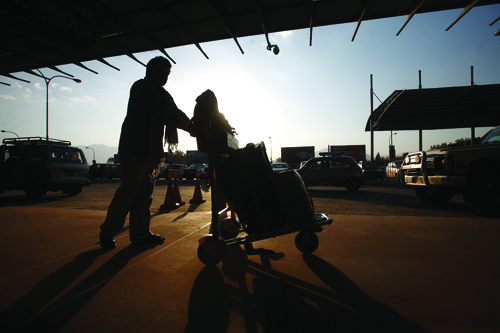
 A migrant worker leaves Nepal through Tribhuvan International Airport, Kathmandu. Photo: Gopen Rai
Dambar Krishna Shrestha in Himal Khabarpatrika, 2-8 August
Nepal's labour recruiters went on strike last month for the right to keep on cheating poor migrant workers and make them pay for their visas and tickets. Thousands of workers waiting to board flights to Malaysia and the Gulf were held hostage until the government relented.
They agreed to lift the strike but are now using all their political connections to abort the government decision which would have required employers abroad to pay for the ticket and visas of Nepali workers.
 The agreement between labour recruiters and the government looks like a ploy. Labour Minister Tek Bahadur Gurung knows he will no longer be in government by the time the three months comes to an end, while the recruiters now have time to lobby for a rollback.
Labour recruiters started picketing the office of the Department of Foreign Employment at Tahachal, stopping pro- zero cost migration agencies from applying for labour permits. After a series of failed negotiations, they accepted the policy on 25 July for three months. But they compelled the government to revise the policy by forming a high-level committee.
The committee led by Labour Secretary Surya Prasad Shrestha also has representatives of labour recruiters as its members. The committee will visit Malaysia and the Gulf countries in the coming months, find out if employers are ready to provide free tickets and visas and submit a report within two months. The government will revise the policy if necessary based on the report.
Although Labour Minister Gurung is adamant he will not backtrack, there are fears that he will be forced to do so when the Shrestha committee submits its report. Powerful manpower agencies have already convinced Prime Minister Sushil Koirala that the policy will have negative impact on migrant workers and the remittance-driven economy.
 Koirala reportedly asked Gurung to not implement the policy, but the minister balked. Koirala then sent instructions in writing to Gurung to implement the policy only after signing a Memorandum of Understanding (MoU) with destination countries.
"On the pretext of signing MoU with destination countries, a pro-poor policy is being aborted,” migration expert Ganesh Gurung told us. Labour recruiters appear determined to force Gurung to withdraw the policy because it will prevent them from squeezing outbound migrant workers.
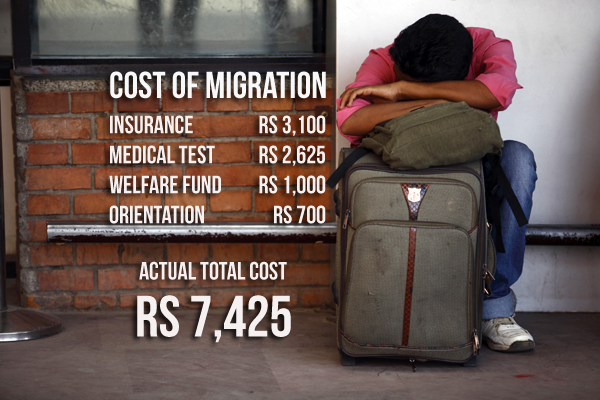
Even before the zero-cost policy was announced, nearly 45 per cent of employers in Malaysia and the Gulf used to bear the cost of migrant workers' airfare and visa fee. But Nepali labour recruiters would share this money with their counterparts abroad. Most migrant workers were overcharged Rs 200,000 for airfare, visa fee and insurance.