
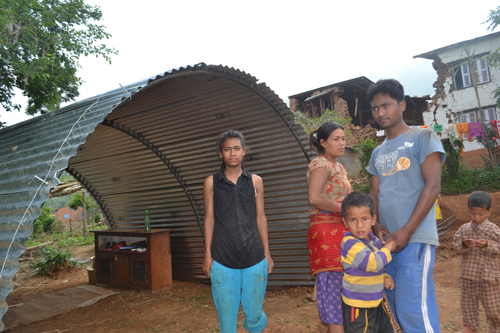
 Chiran Magar builds a safer temporary shelter behind his damaged house in Chalnakhel, Kathmandu. Photo: Om Astha Rai
Om Astha Rai
Chiran Magar, a 29-year-old mechanic, spent over the last two weeks under a makeshift tent after the 25 April earthquake damaged his house.
"Life was hard under the tent," says Chiran. "It used to be more difficult when it rained, my little children would fall sick under there."
Early this week, Chiran's family moved to a safer shelter house made of iron rods and corrugated sheets.
"It's much better here," he says. "We're less worried about the rain."
Chiran built the shelter house by using materials provided by Karuna Foundation, a Netherlands-based NGO, working in Nepal since 2007.
In Chalnakhel village, situated on the southern outskirts of Kathmandu Valley, Karuna Foundation has provided materials to build temporary shelters to 60 families. While 10 families are building temporary shelter houses like Chiran's, others are using the corrugated sheets as roofs for their new houses.
The arch-shaped shelter house built by Chiran costs less than 100 USD (Rs 9,600). It requires just three pieces of iron rods and nine pieces of corrugated sheets, apart from nuts, bolts and iron wires.
"These shelters are safer and stronger than tents, yet cheap and easy-to-built," says Chet Kumar Khatri, a civil engineer specialised in earthquake engineering. "If we have all the materials ready, we can build a shelter in less than an hour."
Khatri is guiding people to build cheaper, safer and stronger shelters in Chalnakhel, where nearly 80 per cent houses have been damaged by the earthquake. He says: "These shelters can also be moved to different locations."
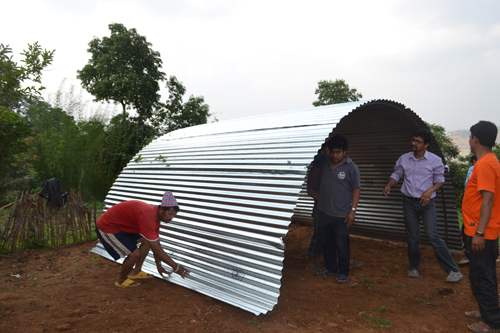 More villagers are building safer temporary shelters in Chalnakhel, Kathmandu. Photo: Om Astha Rai
Karuna Foundation has received support from Dutch NGOs like Reach Out 2, Femi Foundation, Netherlands Leprosy Relief and Liciane Foundation to help build temporary shelters for more than 2,000 displaced families.