
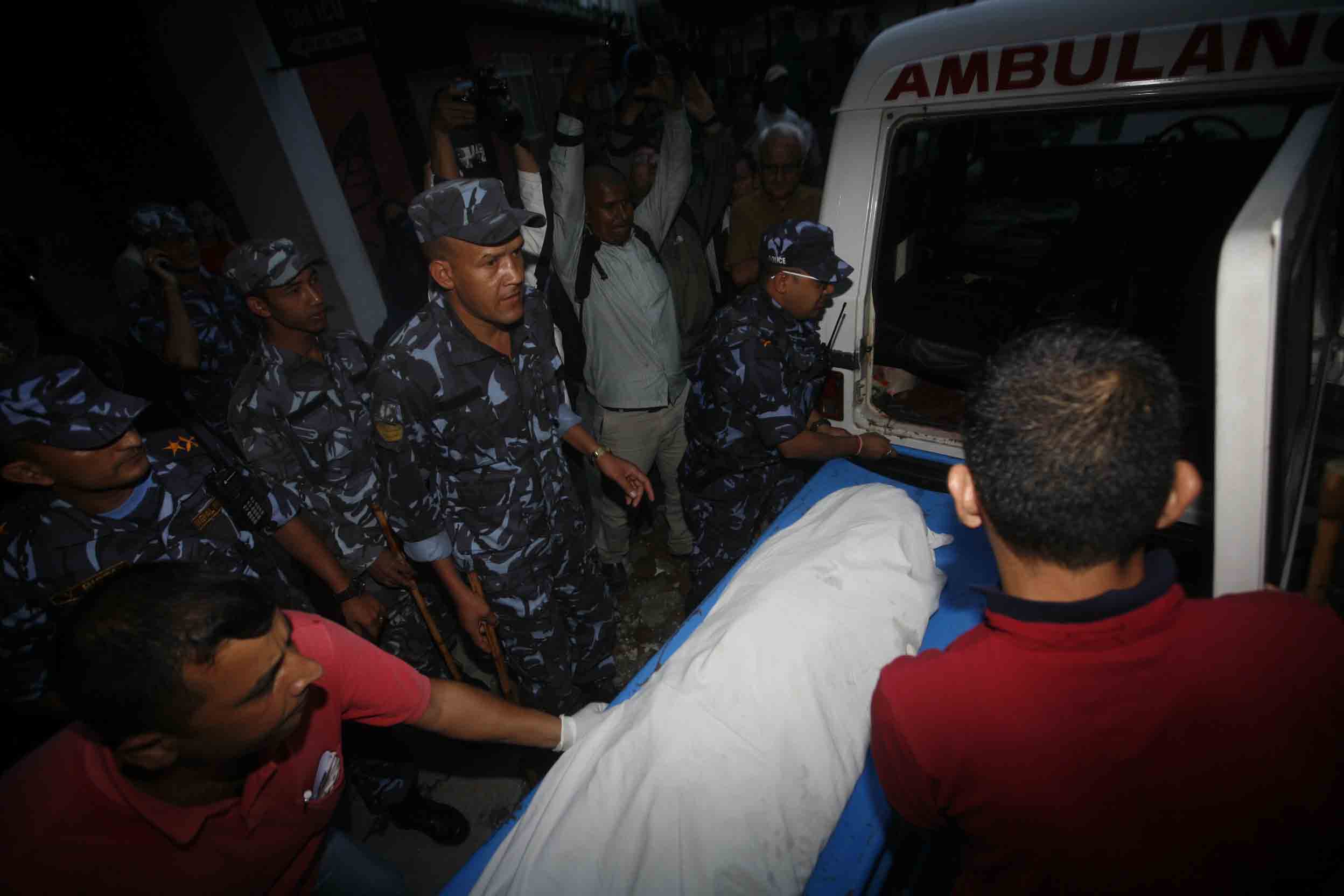
 The body of Nanda Prasad Adhikari being taken into an ambulance in Bir Hospital on Monday. Photo: Bikram Rai
Nanda Prasad Adhikari, who had been on hunger strike for 11 months to demand justice for the war-time murder of his son, died on Monday afternoon at Bir Hospital. His wife, Ganga Maya, is still on hunger strike and knows that her husband is now dead.
The elderly couple had been on intravenous feeding in the hospital’s intensive care unit for the past year. Nanda Prasad, who was just skin and bones, slipped into unconsciousness five days ago, but had been revived. On Monday, his condition deteriorated and the end came at 5PM.
The Adhikari couple want justice for those accused in the murder of their son, Krishna Adhikari, and they went on a fast when their pleas went unheeded by successive governments.
Krishna Adhikari was 18 years old when the Maoists took him away from his home in Phujel of Gorkha district on 4 June 2004. His body was later found in Chitwan after he had been tortured by being dragged behing a motorcycle in a sack. Nanda Prasad and Ganga Maya went to the National Human Rights Commission, civil rights activist groups, the police, and district administration to lodge a complaint. No one listened to them. Back in Gorkha the Maoists hounded them, killed all their livestock and chased them out of their homestead in Phujel.
So, out of desperation and with nothing left to lose, Nanda Prasad and Ganga Maya came to Kathmandu in January 2013 and staged a hunger strike outside Prime Minister Babu Ram Bhattarai’s official residence in Baluwatar. The police picked them up and dragged them to the Kamal Pokhari Station, where they were illegally detained for 48 days. Later, they were handcuffed and taken back to Gorkha in a jeep and dumped there, even though the Maoists had evicted them from their home.
The couple returned to the pavement outside Kathmandu’s Bir Hospital again in a hunger strike protesting the lack of police action against their son’s killers. Passers-by would crowd around them, but their plight was often drowned in a capital with so much misery.