

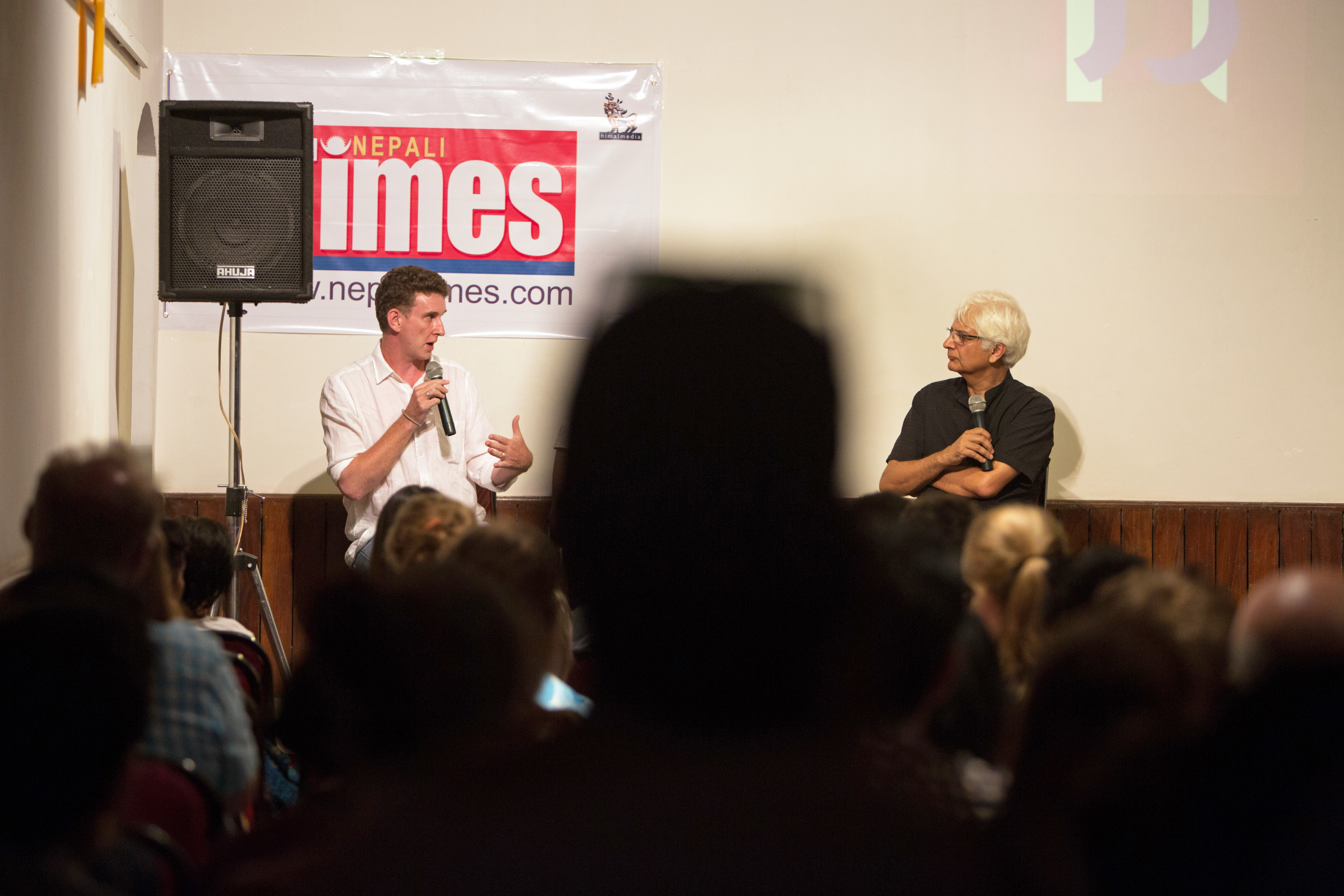
 Photographer Nic Dunlop (left) at the 'Burmese Days' talk with Nepali Times editor Kunda Dixit and author Emma Larkin. The name is a pseudonym that has allowed her to go in and out of Burma. To continue doing so, she requested not to be photographed.
On Friday the 13th, auspiciously the same evening that Burmese democracy leader Aung San Suu Kyi arrived in Kathmandu, Nepali Times hosted “Burmese Days,” a talk on the transition of Burma from military dictatorship to democracy.
Writer Emma Larkin and photographer Nic Dunlap shared insights from their work from more than a collective 30 years in Burma, and answered questions from a full lecture hall at Yala Maya Kendra in Patan Dhoka.
Emma Larkin is a pseudonym that allowed the writer to travel throughout, research, and author two books on Burma. Larkin discussed Finding George Orwell in Burma, a travelogue of her experiences in Burma. Finding, seeing, and gaining access while in Burma was part of the process and struggles of her work.
“Burma was an amazing place to travel around as a tourist, because you know there’s a dictatorship, you know there are political prisoners, you know there is a civil war, but you can’t actually see anything,“ Larkin says. “You can have this disturbing and intriguing phenomenon of an invisible dictatorship.”
Photographer Nic Dunlop had his own difficulties with this phenomenon. In his first trip to photograph Burma, he too was told about the military dictatorship. But how do you show something that you can’t see?
"There are no soldiers around. There were no guns,” Dunlop says. “We often see stories of victims, but we rarely see the other side. It made me doubt why I chose photography as my medium.”
Dunlop’s work, from over 20 years in Burma, is published in his book Brave New Burma. Many of those exclusively black and white photos were featured in a slide show Friday evening, and he told the story behind them.
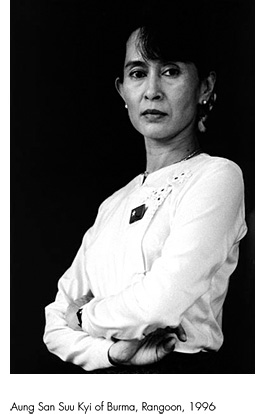 Portrait of Aung San Suu Kyi by Nick Dunlop
Dunlop took the famous portrait of Ang San Suu Kyi while she was under house arrest (pic, left), and discussed what he was trying to achieve, but there’s more than the intended take away.
“I wanted to reflect something of her moral courage and defiance of a dictatorship,” Dunlop says. “But you can glean many different stories from a single image. That restored my faith in photography.”
Both Dunlop and Larkin emphasized that the situation in Burma today and over the course of their work was not so black and white—it was not good vs evil. On the role of the changes in Burma, Larkin was very interested on the long term psychological effects of 50 years of a military dictatorship has on people.
“The breakdown of trust was one of the more insidious things I saw,” Larkin says. “How does that affect you on a long term basis?”
There is more press freedom than ever in Burma, but finding answers to important questions like this is as challenging as ever.