
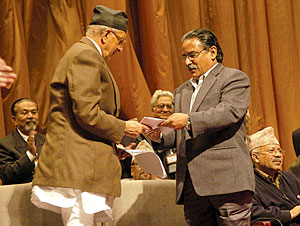
 Then-Prime Minister Girija Prasad Koirala and rebel leader Pushpa Kamal Dahal signing the Comprehensive Peace Agreement in Kathmandu on 21 November 2006.
As Nepal marks the tenth anniversary of the Comprehensive Peace Agreement (CPA) that formally ended the decade-long Maoist war, the peace process may not be as fragile as feared before, but is far from complete.
When Prime Minister Girija Prasad Koirala and the rebel leader Pushpa Kamal Dahal (Prachanda) signed the CPA on 21 November 2006, it fuelled hope for peace and prosperity among Nepalis exhausted by the decade-long war in which 17,000 people were killed.
Dahal is now Prime Minister for a second time, and said this week that the first 10 years of the peace process were “encouraging” as integration of ex-combatants into the army, promulgation of the constitution through an elected assembly and declaration of a republic became possible in this period. He also claimed that Nepal's peace process moved relatively faster than in many other countries.
Political analysts agree that Nepal's peace process has achieved major milestones in the last decade, and is unlikely to unravel. After all, Dahal is in a coalition with his erstwhile mortal enemy, Sher Bahadur Deuba of the Nepali Congress as his partner. Particularly after the promulgation of the new Constitution, the probability of former rebels deviating from the political mainstream is slim.
But a section of former rebels led by Netra Bikram Chanda is threatening to take up arms again. "The relevance of the CPA expired long ago, when the first Constituent Assembly was dissolved," said Guna Raj Lohani of the Chanda-led Maoist faction. "The country is now regressing, and we need a sustained struggle against this parliamentary system. If the state suppresses us, we are prepared to retaliate."