

Political uncertainty and bureaucratic hurdles have forced the two oil exploring companies in Nepal to shelve their plans.
Scottish company Cairn Energy and American company Texana, which hold potential petroleum sites in the Tarai belt, have both cited force majeure, and suspended their operations in the first week of June. The clause allows a party to not fulfill its obligations if circumstances are unfavorable. Both companies had used the clause earlier during the insurgency period.
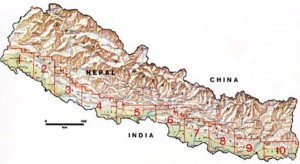
The Tarai-northern extension of Indo-Gangetic plain and Siwalik Range of Nepal have been divided into 10 exploration blocks of 5, 000 sq km each. Texana was granted license to work in two blocks in December 1998 (3 and 5). Five other blocks (1,2,4,6 and 7) were awarded to Cairn in August 2004.
“We have completed the preliminary surveys and now had plans to conduct seismic surveys which involved very high investment,” says Bharat Jnawali, representative of Cairn in Nepal. “We had applied to the government to restructure our work-plan in alignment to the present conditions but we did not receive a positive response. At present, there is no other choice.”
Texana has also been seeking to transfer its rights to Patriot Petroleum Corporation, a Canadian company, using a clause in the original agreement between the company and the Nepali government since December 2011. However, Texana has not received a positive response to its request. There is indication that Texana will initiate an international arbitration against the Nepal government.
Both companies pay a fee of US$ 50,000 per block to the government annually. Texana has already spent US$3 million and Cairn US$20 million in the country so far.
Probabilities of finding oil wells in Nepal lies in our geological environment. Oil has been found in India and Pakistan in areas with similar topography. The government has opened bids in remaining blocks, but with Texana and Cairn skeptic, it is unlikely that other companies will be keen on working in Nepal.
Paavan Mathema
READ ALSO:
Cairn still in wait-and-see mode, #589
Oil company says it won't drill in Nepal until the investment climate improves
MARK WILLIAMSON in EDINBURGH
Dirty business, #589
If we want to encourage investors we have to change the rules of the game
PAAVAN MATHEMA
Oil dreams
Political uncertainty and beuracratic hurdles have forced the two oil exploring companies in Nepal to shelve their plans.
Scottish company Cairn Energy and American company Texana, which hold potential petroleum sites in the Tarai belt, have both cited force majeure, and suspended their operations in the first week of June. The clause allows a party to not fulfill its obligations if the circumstances are unfavorable. Both companies had used the clause earlier during the insurgency period and had resumed work few years ago.
The Tarai-northern extension of Indo-Gangetic plain and Siwalik Range of Nepal have been divided into 10 exploration blocks of 5, 000 sq km each. Texana was granted license to work in three blocks in December 1998. Five other blocks were awarded to Cairn in August 2004.
“We have completed the preliminary surveys. We now have to conduct seismic surveys which involved very high investment,” says Bharat Jnawali, representative of Cairn in Nepal. “We had requested the government to restructure our workplan in alignment to the present conditions but we did not receive a positive response. At present, there is no other choice.”
Texana has also been seeking to transfer its rights to Patriot Petroleum Corporation, a Canadian company, using a clause in the original agreement between the company and the Nepali government since December 2011. However, Texana has not received a positive response to its request. There is indication that Texana will initiate an international arbitration against the Nepal government.
The two companies pay a fee of US$ 50,000 per block to the government annually. Texana has spent US$3 million and Cairn US$20 million in the country.
The chief rationale behind probabilities of finding oil wells in Nepal is its geological environment. India has been producing petroleum in Assam that is geologically similar to Nepal. The same environment stretches up to Pakistan which also produces petroleum.
.