
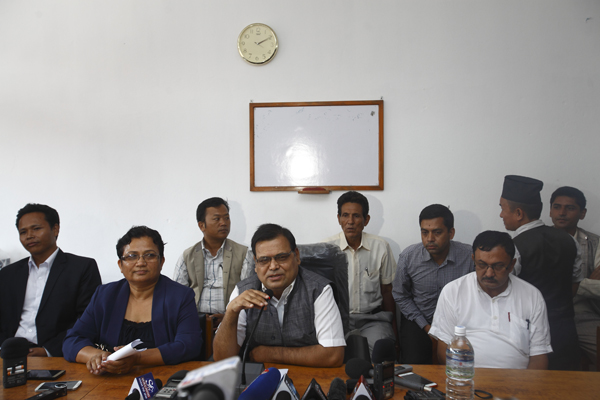
 Maoist leader Krishna Bahadur Mahara and spokesperson Pampha Bhusal at a press conference in Kathmandu on Tuesday. Photo: Gopen Rai
Two months after foiling an NC-Maoist coup that nearly ousted him from power, Prime Minister KP Oli's government is in trouble yet again.
The ruling coalition led by Oli's UML party has unravelled, with the Maoists suddenly pulling the rug out from under it. The government will survive only if Oli can persuade the CPN (Maoist-Centre) Chair Pushpa Kamal Dahal to withdraw his decision — just as Oli did two months ago. However, the probability of Oli being able to succeed again is slim. It will also be difficult for him to forge a new coalition with other parties.
At a hastily-called press conference in Kathmandu on Tuesday just hours after Dahal sent a letter to PM Oli saying his party is no longer in the government, Maoist leader Krishna Bahadur Mahara claimed that the main opposition NC has agreed to support Dahal as the new Prime Minister.
"Our party Chair will be the new Prime Minister, and he will pave the way for the NC President Sher Bahadur Deuba to lead the government in the second phase of the Constitution-implementation process," Mahara said.
We asked Balkrishna Khand, one of NC President Sher Bahadur Deuba's confidantes, to verify Mahara's claim. He said the NC has not decided anything yet, but is open to allow Dahal to lead the government for a certain period.
Nepal’s politics has been thrown into turmoil ever since Oli announced local, provincial and national elections by January 2018 as stipulated in the Constitution. His statement set off an intense power struggle between parties to try to be in government when elections are held, so as to benefit from the incumbent advantage of having control over state resources and apparatus during voting.
In the first week of May, the NC and the Maoists were about to sign a pact to unseat Oli and form their own government. But Oli astutely saved his government by signing a nine-point agreement with the Maoists.
The CPN (Maoist-Centre) says it had also reached a gentlemen's agreement with the UML, requiring Oli to step down and support Dahal as new Prime Minister after the budget. But Oli and his lieutenants denied having any such agreement with the Maoists. In the letter to PM Oli on Tuesday, Dahal justified his party's decision blaming Oli for failing to implement the nine-point agreement and the gentlemen's agreement.
The first of the nine points of the UML-Maoist agreement is about forming an all-party government. However, even afterTuesday's political drama, forming a government that includes all the major parties is not possible. The UML might try to outsmart the Maoists by forming an alliance with the NC. But that is unlikely because one of the reasons presented by the NC to unseat Oli is that his government has failed to address Madhesi issues, and Madhesi leaders are presently averse to joining any coalition that includes the UML.
Oli has refused to step down, and says he will face a no-confidence motion in Parliament. His departure will have ripple effects across the political spectrum. Madhesi parties that have been staging a relay hunger strike at Khula Manch for the past two months will use the fall of the Oli government as an excuse to end their prolonged agitation. They might also join the Maoist-NC government if there is an agreement to amend the Constitution.
However, orthopaedic surgeon Govinda KC's indefinite hunger strike demanding reforms in the medical sector is now in deep trouble, as the interim government will not be able to meet his demands, one of which seeks to impeach the chief of the Commission for the Investigation of Abuse of Authority (CIAA) Lokman Singh Karki for overstepping his mandate by interfering in medical exams. With the political parties now more focused on forming the new government, Karki might not have to face even a parliamentary probe, let alone impeachment.