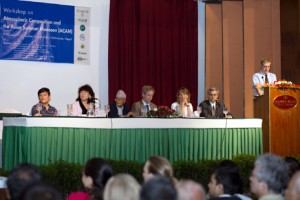
The biggest ever gathering of international atmospheric scientists in Kathmandu this week has concluded that air pollution is affecting the Asian summer monsoon, and changes in monsoon patterns here affect the global climate.
The Asian summer monsoon has implications on the weather, people’s health, agriculture, and glaciers of the entire Himalayan arc from Afghanistan to Burma, and this is being affected by increased pollution from population density and increased affluence in China, India and Southeast Asia. However, scientists said there is a need to improve understanding of the underlying sources and processes driving these changes.
“The functioning of the Asian monsoon and its connection to air pollution is a major concern in Nepal and the entire region,” said Rabindra Shakya, Vice-Chair of the Nepal National Planning Commission, “the monsoon is important to sustain life, but it also brings cloudbursts, floods and landslides. Understanding what is driving changes in the Asian summer monsoon is important.”
The meeting, organised by the Kathmandu-based ICIMOD (International Centre for Integrated Mountain Development) and its Atmosphere Initiative together with the US National Science Foundation, the National Center for Atmospheric Research (NCAR), the International Geosphere Biosphere Programme’s Integrated Land, Ecosystem, Atmosphere Processes Study (iLEAPS), the International Global Atmospheric Chemistry Project (IGAC), and the World Climate Research Program’s core project on Stratosphere Processes and their Role in Climate (SPARC) .
“Asia is witnessing rapid economic development and population growth. As a result, man-made emissions are on the rise. The interaction between these changes and the Asian summer monsoon is affecting the composition of the upper levels of the atmosphere, which in turn can affect the climate of the entire northern hemisphere,” said the meeting’s co-chair, Laura Pan, atmospheric scientist at the US National Center for Atmospheric Research (NCAR). With more than 100 participants, the workshop on the Atmospheric Composition of the Asian Monsoon shared knowledge and develop collaborative efforts to improve understanding on the links between pollution and monsoons.