

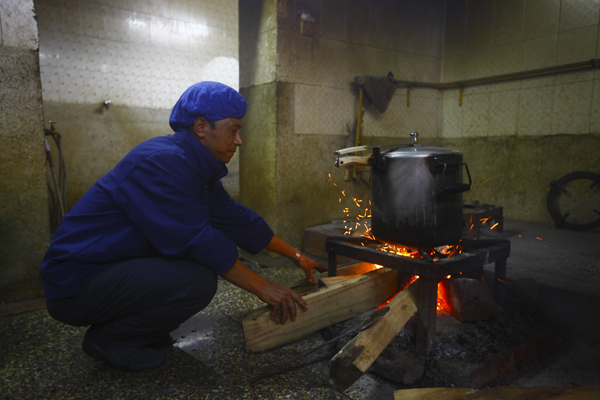
 FIRESIDE: Yubhan Tamang, 39, has been cooking over a firewood stove to feed 300 patients everyday at Bir Hospital for the past one and half months. Pic: Gopen Rai
After last week's failed talks the government and the Madhesi parties are back to old games: wait for the other side to blink first. The security forces and the protesters are now engaged in a tug of war to control movement along the East-West Highway.
As tension escalated across the eastern Tarai after three deaths in police firing this week in Saptari, the government even mulled deploying the army to quell protests. But the army wisely advised the government to seek a political solution.
The government then decided to deploy the Police and Armed Police Force (APF) along the highway. Laxmi Dhakal, spokesperson for Ministry of Home Affairs, said: "We will not allow anyone to block the highway."
The government's special security plan has deterred Madhesi protesters from gathering on the highway, but it has also infuriated them. "It's a ploy to not let talks succeed," said Laxman Lal Karna of Sadbhavana Party. "We can't sit for talks if the government uses force against our people."
With both sides employing pressure tactics, chances of resumption of talks are slim. But informal consultations continued this week between the two sides, between chief negotiator Pushpa Kamal Dahal and Prime Minister KP Oli, and between Oli and the Indian ambassador.
Even if both sides agree to sit for formal talks again, there is very little possibility of a breakthrough. The main issue is the fate of three districts in the eastern and two in the western Tarai. NC and UML hardliners like Sher Bahadur Deuba, Krishna Sitaula and Bhim Rawal want them to be part of the hill provinces, while the Madhesi parties want the districts to be included entirely in the two Tarai provinces.
The Madhesi parties view the movement as a battle for their political survival, and it will not be ready to compromise unless parts, if not the whole, of the five disputed districts are inserted in the Madhes province. PM Oli is equally adamant, he said this week: “I don’t know how many more days I will survive, but I will work for the Nepali people till I die.”
New Delhi, the third and probably the most important player in this brinkmanship, is also waiting for Kathmandu to concede to Madhesi demand on demarcation of Tarai provinces. Realising that he cannot mend his relations with New Delhi, Oli is trying to do something to be remembered by as a true nationalist before his tenure as probably Nepal's shortest-term prime minister ends.