

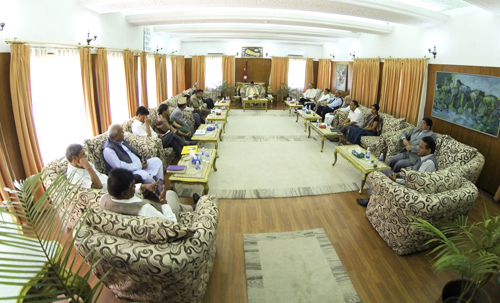
 Leaders of major political parties inform other parties about progress made in constitution writing in a meeting held on Saturday. Photo: Kumar Shrestha, RSS
After years of bickering over issues of state reconstruction, a new constitution now looks like a possibility in Nepal.
With major political parties – the ruling NC-UML and the opposition Maoist-Madhesi – reaching an understanding on the contentious issue of the new constitution, the prolonged political deadlock looks set to end sooner than later.
On Saturday, the ruling coalition and the main opposition held a meeting with the fringe political parties present in the Constituent Assembly (CA). In the meeting held at Prime Minister Sushil Koirala's official residence, the ruling and opposition leaders informed the fringe parties about the progress made in the constitution writing process.
The ruling and opposition leaders informed the fringe parties that they had agreed to write the new constitution by putting the names and boundaries of federal provinces on hold. After the meeting, NC leader Ramesh Lekhak told journalists that the fringe parties reacted positively to the understanding reached between the NC-UML and the Maoist-Madhesi.
As per the understanding, Nepal will have six-eight federal provinces. But names and boundaries of these federal provinces will be determined by future provincial councils and the proposed State Restructuring Commission. While the NC-UML are pushing for six provinces, the Maoist-Madhesi want eight provinces.
Similarly, 60 per cent of parliament members will be elected directly while 40 per cent will be chosen from the Proportional Representation (PR) quotas. Political leaders say they have already ironed out the issues of judiciary and form of governance.
Sources say political parties, particularly the UML and the Maoist-Madhesi, have also agreed to form an all-party government soon after writing the new constitution. NC president and Prime Minister Koirala has maintained that he will step down only after writing the new constitution.
After the 25 April earthquake, all major political parties except the NC look in favour of what they describe as a national unity government to undertake the reconstruction and rehabilitation projects.
Also read: