
Japan’s natural disaster preparedness was offset by man-made perils
JEMIMA SHERPA in HACHINOHE, JAPAN
When the magnitude 9.0 earthquake struck in Hachinohe in northern Honshu Friday afternoon, the shaking seemed to go on for an eternity. Despite the panic, I thought, “I’m so glad this is happening in Japan and not back home,” imagining for a moment the devastation that a quake which merely makes power lines swing wildly and buildings creak here might have wrought in Kathmandu. In my eight months in Japan, earthquakes have been frequent and often strong. During a 7.2 the previous Wednesday, my Japanese co-workers seemed unfazed, merely standing up on the alert rather than ducking for cover.
The power outage was the first indicator of the seriousness of Friday’s quake. Here in Aomori prefecture, damage seemed minimal – my telephone had fallen off its perch and danced across the floor, and spice boxes tumbled across the countertop. While dire predictions of what will happen when even a modest earthquake hits haphazard, overcrowded Kathmandu have been around for decades, Japan is lauded for its meticulous disaster planning and strict building codes, especially following the 1995 Kobe earthquake. Even my second-floor apartment is constructed to sway accommodatingly during seismic activity, and every neighbourhood is close to at least one school or public building that doubles as an emergency contact centre and refuge – one nearby sheltered 1,800 people.
Damage from the earthquake itself was minimised, but as an island nation tremors are only the beginning of the crisis. Heeding a tsunami warning, a friend and I evacuated to the school I work for to spend the night. Despite strong aftershocks, the atmosphere was surreally calm. We cruised through the city towards the hills, the legendarily courteous Japanese nodding and bowing their way through intersections with defunct traffic lights. Stopping at a combini, a ubiquitous convenience store, we grabbed junk food off emptying shelves before joining a snaking but orderly queue to pay. “Anywhere else we could have just been looting by now,” we joked feebly.
The school was stocked with emergency lights, battery-powered radios, kerosene heaters to combat snowy night temperatures, and a varied selection of instant ramen and energy drinks. Other evacuees arrived with well-packed emergency bags, putting our hastily assembled jumble to shame, and were duly documented. Teachers even had hand-powered dynamos to recharge their mobile phones, which are built to pick up television signals – we watched news being broadcast by presenters in hard hats under lights swaying from aftershocks. The electricity and high-speed internet services were off for less than 36 hours in some neighbourhoods, and water supplies unaffected. Cell phone reception was patchy but often still serviceable. Even amidst reports that this was Japan’s biggest earthquake on record and that the larger city of Sendai, a four-hour drive south, was being ravaged by the tsunami and spreading fires, for many people in Hachinohe the conditions were arguably an improvement on your average winter Friday evening in Kathmandu.
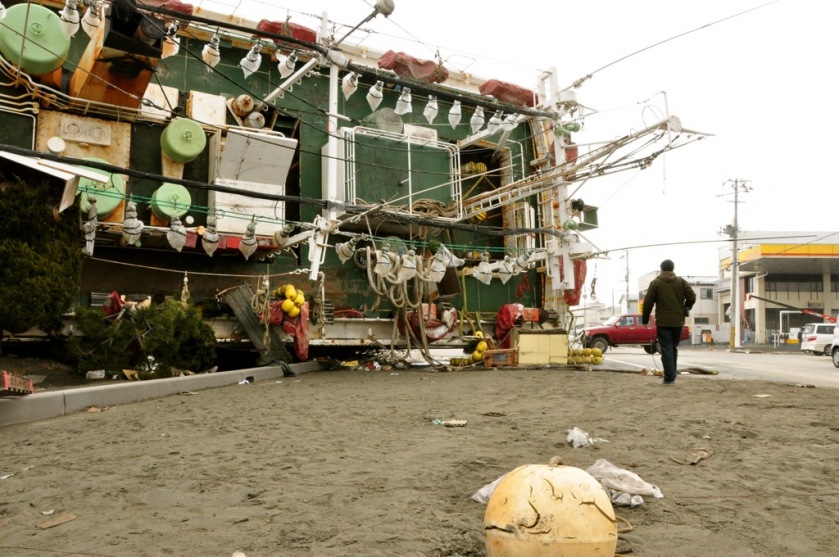
Only driving through the devastated port areas the next day did the extent of the damage become apparent. In a city where the fishing industry powers the local economy, fishermen were surveying beached shrimping boats and smashed trawlers. Cars were tipped and lodged almost comically against buildings, and the streets were full of debris and a thick sludge, which later dried out into a fine dust. When power was gradually restored from Saturday evening on, news footage showed that Aomori had been extremely fortunate in comparison to neighbouring prefectures to the south.
Even more worryingly, the initial explosion at the Fukushima reactor was dominating coverage even as rescue and recovery workers scrambled to find survivors. Further explosions, venting of radioactive material and fires plagued the plant, until Tuesday the government announced radiation in the area had reached levels dangerous to human life.
Japan began producing nuclear power in the 1960s, and the country’s enviable infrastructure and status as the world’s third largest economy is reliant on its thermonuclear power program. Speculation is rife that officials may be downplaying the risk involved, as the over 50 other plants must continue to function for the Japanese economy to attempt recovery. By mid-week other producers of nuclear power, including Germany, the US and Russia, were also facing debate on their thermonuclear policies.
In Japan, the national propensity for pragmatism, preparedness and social order greatly reduced the impact of the actual earthquake and the aftershocks, and precluded mass hysteria, looting and price gouging. However, the geographic realities of living in islands with volatile tectonic plates along the eastern coast make the tsunami risk something essentially impossible to guard against. Combined with a nuclear emergency, at this point the total death toll, extent of damage, likelihood of further destruction, and potential timeline for national recovery are all matters of conjecture. Whether the combined earthquake-tsunami-nuclear trifecta of threats ultimately proves more deadly than say, the poverty, poor construction and lack of disaster preparation that marked the Haiti quake in 2010 or the Sichuan quake in 2008 remains to be seen. Certainly, when a quake finally hits Kathmandu, the aftermath will have more in common with the latter two than with Japan or the recent Christchurch earthquake. Our years of unplanned city growth, a new crop of gargantuan high-rise buildings and shrinking open public spaces, along with virtually nonexistent emergency services and government coordination, will all prove devastating.
Most worrying of all, the Nepali public is woefully unaware of how best to prepare for and react to an emergency situation. Japan’s devastation would undoubtedly have been much, much worse without the years of earthquake preparation and drills that preceded it. Still, the steam and smoke billowing from the reactors have something in common with the deadly rubble of massive tofu-constructed buildings in China and even the horror of the BP oil spill. As the world continues to move towards high-density, urban living with ever-increasing energy demands, avarice and hubris prompts us to build systems and structures that ultimately prove as destructive as nature’s worst. In Nepal’s desperation to join the charmed clique of developed countries, too often we unsuccessfully chase their dreams without truly learning from their mistakes. Japan teaches us that it’s always worth preparing for the worst, and that includes keeping our consumption in check.
READ Jemima Sherpa's blog: http://whathasgood.wordpress.com/
READ ALSO:
http://www.bbc.co.uk/news/world-asia-pacific-12725646
http://www.bbc.co.uk/news/world-asia-pacific-12735023
http://edition.cnn.com/interactive/2011/03/world/slider.japan.photos/index.html