

 Researching how young people living in the mountains of Nepal adapt to high altitude may hold clues to the treatment of children who suffer from various disorders which result in too little oxygen in their blood.
A team from the University of British Columbia (UBC) Okanagan Campus in Canada recently took measurements of 60 Sherpa children in Thame and Khunde measuring brain blood flow, oxygen content in the blood, breathing patterns and metabolic rate at rest and during exercise.
“Aside from the adaptations that enable the children to reside comfortably at high altitude I was particularly inspired by their enthusiasm to take part in our research,” said Laura Morris, one of the Canadian scientists. “Many had seldom seen or ridden a bicycle before, but were willing to happily perform maximal exercise tests.”
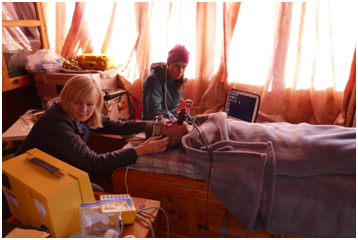
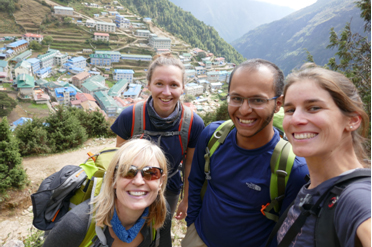 SEARCHING FOR CLUES: Canadian and Nepali esearchers Laura Morris, Ali McManus, Shailesh Niroula, and Daniela Fluck in Namche, and measuring oxygen in a Sherpa child in Thame.
The team also included Ali McManus, Daniela Fluck and Audrey Kirby, as well as Kami Sherpa, head of medicine at the Khunde Hospital and Kathmandu-based physician Sailesh Niroula. The team is now analysing the data at UBC and hopes to better understand the changes the young body makes when it lacks oxygen. “Ultimately we hope this work will help develop better treatment for children who suffer from disorders that reduce the oxygen in their blood.”
“Testing the unique physiology of Sherpa children was a remarkable experience,” said Fluck, a Swiss researcher with UBC who assessed blood flow in the arteries leading to the brain using ultrasound in children who were born and live at nearly 4,000 m.
Niroula said that it was his first time in Khumbu, and was pleasantly surprised by how excited the children were to pedal on the exercise bicycle, as well as the enthusiasm of their parents.