

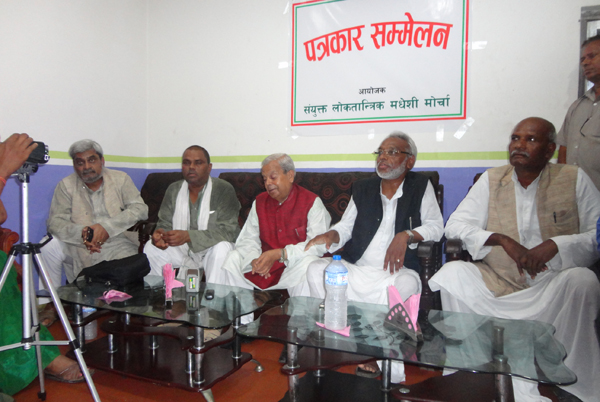
 File photo: Shrawan Kumar Deo
From the Nepali Press
Roshan Kumar Jha in www.ratopati.com
When Madhesi Morcha launched an agitation against Nepal's new constitution five months ago, no one anticipated that the crisis would drag on for so long. But even after the death of 50 people and 20 rounds of talks, the unrest in the country's southern plains continues.
There could be multiple factors behind the delay in finding a way out of the crisis, but division among the top Morcha leaders is the biggest one. Had they been able to overcome their rivalry, they could have forced the ruling parties to address Madhesi demands much earlier.
Sadbhavana Party's Chair Rajendra Mahato has always tried to be seen as the messiah of the Madhesi people. This is why he sometimes ends up making silly decisions. He recently announced separate protests but returned to the Morcha after Madhesi people refused to rally behind a single party.
Mahato is still boycotting talks with the government, demanding an apology from Prime Minister KP Oli for the police attack on him in December. His impulsive behavior and frequent attempts to outsmart other Madhesi leaders do not bode well for their collective movement.
But other Madhesi leaders also need to be criticised for their lack of zeal to fight on the streets. While Mahato has hardly left Madhes after announcing an indefinite strike in August, other leaders are mostly busy in Kathmandu for futile talks with the ruling parties.
When Mahato was hospitalised after being thrashed by police, other Madhesi leaders did not even bother to see him. Worse, Upendra Yadav accused him of trying to cheaply gain popularity.
Acrimony between Mahato and Yadav is not new. They have always tried to belittle one another. While Mahato claims to be the only scion of the late Madhesi leader Gajendra Narayan Singh, Yadav believes he deserves full credit for leading the first successful Madhes uprising in 2007. They do not tolerate each other's political existence. After being left out of the constitution writing process, they have joined hands but their rivalry is still alive.
Yadav is a mature and intellectual leader. His understanding of social dynamics of the Madhesi is probably better than any other Madhesi leader. But he is a lone wolf. He does not believe in walking hand-in-hand with other leaders. He has thwarted efforts to unite all Madhesi parties in the past.
Mahant Thakur is the most seasoned of the top four Morcha leaders. But he is still seen by many in Madhes as a Nepali Congress agent. He is old, slow and still living in the hangover of congress politics. He hardly leads street protests, and his party looks like a club of retired intellectuals.
Mahendra Ray Yadav, the fourth Madhesi leader, was also in Thakur's party. But he formed his own party as Thakur favoured only Madhesi Brahmin and other high-caste leaders. For a leader to rise in Thakur's party, he needs to be from a Madhesi high-caste. Other leaders hold the same view: Mahato's party is dominated by leaders belonging to Suri, Teli and Kalwar castes.
Madhesi people believe that their leaders need to be united if their voices are to be heard.