

The soaring temperature and delay in monsoon has reigned havoc in various districts across the country. From Mechi in the east to Mahakali in the far west, every eye is now fixed towards the sky , but not just with hope and anticipation, some in fear and distress.
The strings of fire this year have left hundreds of families in Madhes either homeless or hopeless under burden of debt. On 24 April, more than 250 houses were burnt down in separate incidences involving four VDCs of Saptari district. Barely a week later, 20 poor Muslim families of Sunsari’s Bhutaha VDC lost their home due to fire that spread from a local cow shed . Two weeks later, on 15 May the devastating fire in Aurhi and Shivnagar (pic) of Siraha district gutted more than 600 houses leaving at least 2500 people homeless. 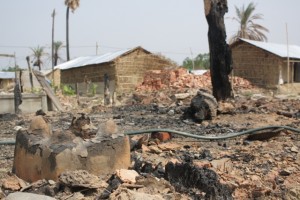
The fire which broke out in Jamunaha VDC of Banke district on Tuesday this week destroying 150 houses has claimed another 45 houses after another mishap on Friday. A separate fire in district’s Rambhapur VDC also gutted down 72 houses, killing at least 1 person.
The extent of damage in each of the incidents may not sound astronomical but in almost all the cases, it has claimed lifetime savings of the families in the form of house, cattles and belongings. The government has tried to arrange basic relief materials and temporary shelters for the victims but this monsoon, they will have to combat both rain and the disease.
While the southern plains of the country is ravaged by devastating fire, the soaring temperature and drying rivers has caused water shortage in the valley as KUKL struggles to meet the bare minimum demands of the overpopulated valley. The temperature of the Kathmandu valley has already hit 35 degrees this season
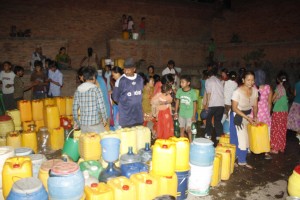
One of the areas worst hit by water shortage is Gwarko and area around Patan Durbar Square. “ It has been two months, not a drop of water runs down the kitchen taps.”, complained Phul Maya Jyapu who was waiting in queue with her two jars at a dhungedhara (traditional underground water tap) in Patan Durbar Square.
The locals of Patan get water once every five days, but only those with powerful machines attached to the pipes manage to suck out few gallons to store for the week. Remaining have to stand in long queues at dhungedharas for hours like Phul Maya. “ I do not have any choice. I left my two kids alone at home in order to fetch water.”, said Rita Magar who had managed to fill three jars after standing three hours in the queue. But Sushila Bhandari did not have to wait for that long to get two bottles of water because she was carrying her one year old baby.
 According to KUKL sources, the people of Kathmandu valley consume 70 million litre of water everyday. This is less than a quarter of what is demanded during the dry season. The much talked about Melamchi project which was supposed to supply valley’s parched population with additional 170 million litre has been in limbo due to sluggish pace of work and local resistance to the project over compensation.
Prime Minister Baburam Bhattarai visited the project site this week and expressed his dissatisfaction over pace of work with the Chinese contractors of the project. The project that has been talked about since the 80s and limited to papers in the last decade, only began construction in 2009 and is supposed to be completed in the next three years.
Anurag Acharya