

From the Nepali Press
Gopal Bhandari in Himal Khabarpatrika, 31 January- 6 February
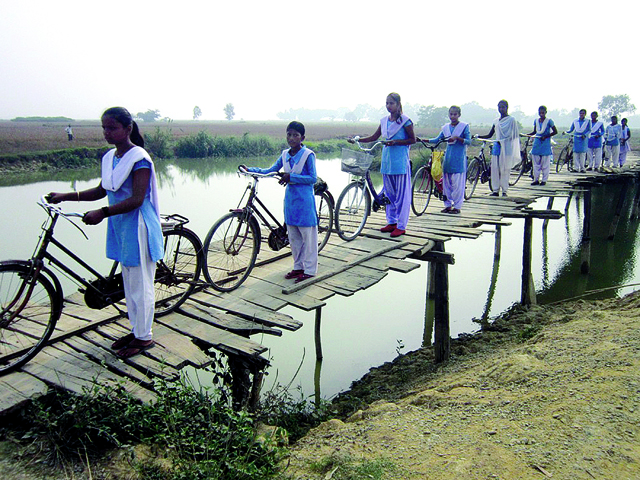
Tenth grader Janaknandini Chaudhary, from Pakdi village in Kapilvastu, has quite the arduous daily commute -- she has to cross an international border to get to school every morning.
Because there are no high schools in her village Chaudhary attends the Shahide Azam Bhagat Singh Higher Secondary School across the border in India.
Though the journey is far from home, Janaknandini feels just as comfortable in the neighbouring country. "It is hard for me to understand or speak in Nepali. Since Hindi and Awadhi are my mother tongues, it is easier to study there," she says. She does not identify with Nepal's national flag and instead of singing the Nepali national anthem every morning, she croons "Jana gana mana..." of the national anthem of India.
Like Janaknandini, more than 20 children in Pakdi cross the border to attend school every day. Since the village only provides schooling up to lower secondary, older students in Pakdi must travel to Rangapur, more than 5 km away, to attend secondary school. But due to travel constraints, some parents opt for an even longer route. "As the road condition to Rangapur is bad, people prefer to send their child to Indian schools," says Pakdi resident Saroj Chaudhary.
Brought up with an Indian education since they were young, growing numbers of children find their intellectual curiosities and affinities being met by Indian society rather than back home. Some are voicing concerns that not enough students are being encouraged to have an interest in issues specifically facing Nepal, which they claim is a symptom of inadequate resources. "Attention needs to be drawn towards providing educational facilities at this side of the border," says civil society member of the district Jayprakash Pandey.
On the other hand, district education officer Hari Gautam claims that the government has already made the expansion of classrooms a priority, but the problem more than anything is about complacency. He says, "If the schools are ready to take the initiative to develop their infrastructure, we are ready to help them with it."