

The lack of political avenues is pushing Madhes to the brink of another violent movement
Analysis by NAVIN JHA
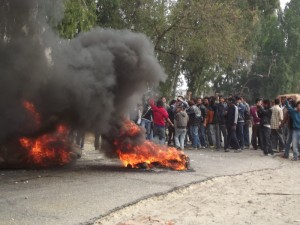
A politicised dispute over relocating the tax office in Mahottari has widened the rift between Madhesi and Pahadi people of the eastern Tarai and threatens to re-ignite hills vs plains violence.
The Internal Revenue Department says it had no intention of relocating the tax office from Janakpur to Bardibas, it was just trying to open a sub-office in Bardibas along the Eat-West Highway. However, political parties took up the issue to launch a protest shutdown in Janakpur last month.
The government backtracked, and this lead to a counter-shutdown of the East-West Highway in Bardibas by people of hill origin, many of whom were forced out of areas further south during the Madhes movement. The agitation shows no sign of subsiding and the Madhesi parties have closed down Jaleswor for nearly three weeks.
“Instead of trying to bring the hills and plains people together, the political parties are trying to widen the divide between them and spread fear and suspicion,” says Birganj based madhesi intellectual, Binod Gupta.
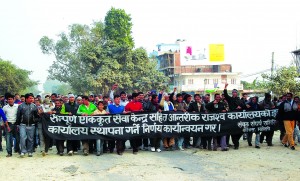
Five years after the Madhes movement, people from the plains have got increased representation in the Constituent Assembly, the president and vice-president are Madhesi and the current coalition has senior Madhesi figures as ministers. However, the lack of development and the continued margnialisation of the eastern Tarai has fed frustration.
On top of that, there is growing animosity among people of hill origin who were driven out of their farms and homes and who now live along the highway.
The other reason for the increase in Madhesi dissatisfaction is that the two contesting proposals submitted by State Restructuring Commission have both divided Madhes into two provinces. While the CA mulls over the issue of federalism, the hardening rhetoric of the Madhesi leaders in the last few indicates which way the wind is blowing.
At a function organised to observe the fifth anniversary of Madhes uprising in Kathmandu last week, the Madhesi leaders and intellectuals made a grim assessment of the last five years. While political access to the power centres of Kathmandu has increased, analysts say the lives of common Madhesi has actually become worse.
The inclusion bill is in limbo and Kathmandu has not been sincere in its commitments. Madhesis do not see themselves apart from rest of the Nepal and their fight against Kathmandu is one for acceptance and inclusion, not for isolation and exclusive identity.
But the hostility of the state and its machinery towards their concerns has further exacerbated the trust deficit. Statistics reveal that in the years following Madhes movement, the access of Madhesis in state bureaucracy, judiciary has gone down and trust in the constitutional bodies like National Human Rights Commission and Supreme Court is at an all time low.
JP Gupta’s statement that Madhesis will sever their ties with the state in near future may be slightly exaggerated but the growing sense of alienation on the past of Madhesis towards Kathmandu is real.
The credibility of Madhesi leaders holding influential position in the government for most of the last five years has taken a battering. They were busy forging passports, extorting businessmen and looting state coffers while condition of people in Madhes went from bad to worse.
The 'anti-Madhes' posture of the mainstream media and political elites put off many moderate Madhesis and their voice is now sorely missed. As a result, the field is wide open and there is a real danger of an anarchic movement sweeping through the plains.
Feeding all this is growing unemployment and the lack of opportunity for Madhesi youth. There is a criminalization of politics, and this has added fuel to the fire.
Unless the discontent in the streets gets a political voice and attention of the state, the Madhes is only waiting for a spark. The Tarai is tinder dry.
Navin Jha is a reporter with Himal Khabarpatrika.