

While the international search for the Malaysia Airlines Boeing 777 that disappeared on a flight from Kuala Lumpur to Beijing a week ago turns to the vast Indian Ocean, in Nepal it has been an eerie reminder of how aircraft have similarly gone missing.
Some have never been found, like the mysterious disappearance of helicopter Charlie Uniform (9N-ACU) (pic, right) which vanished on a flight from the Base Camp of Mt Makalu to Lukla on 31 May 2002. 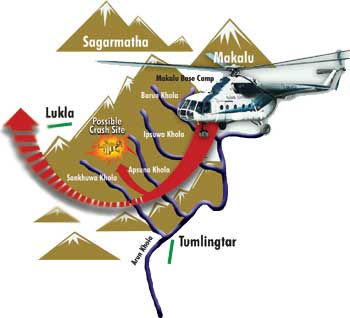
Eight Sherpa porters and two crew members including a Russian pilot were on the Mi17 helicopter which had taken off in bad weather. When the chopper could not be found after weeks of aerial and ground search in extremely rugged terrain during mid-monsoon, the hunt was abandoned.
There were conspiracy theories at the time that it was hijacked by Maoist guerrillas, and the aircraft was in India. But members of an ornithological expedition in the Makalu Barun National Park said they had heard the plane circling over a remote part of the Arun Valley, obviously lost. The accepted theory is that the helicopter hit a mountain and was buried in an avalanche triggered by its impact.
Because flying over the Himalaya is challenging due to terrain and weather, the same factors also make search and rescue even more difficult. In August 1962, a DC-3 Dakota aircraft belonging to Royal Nepal Airlines strayed off course on a flight from Kathmandu to Delhi and crashed killing all four crew and six passenger, which included Nepal’s ambassador to India. The plane was only located ten days later by an Indian Air Force plane on a remote mountain in Dhorpatan. A Pilatus Porter rescue plane that was sent to the area also crashed.
When a Thai International Airbus 310 disappeared on a flight from Bangkok to Kathmandu in July 1992, it could not be located for four days because it had gone completely off course in overcast conditions and crashed into the Himalayas in Langtang National Park 20km north of Kathmandu. With 113 fatalities, this was the second-worst disaster in Nepali aviation history.
Weather and terrain were also factors in locating crashes of other flights, including the Lumbini Air Twin Otter that hit a mountain on a flight from Jomsom to Pokhara in the monsoon of 1996, killed 18 people. When a Mi17 helicopter carrying 22 passengers, including Nepal’s top conservationists disappeared near Kangchenjunga in September 2006, the wreckage could not be located for five days.
The latest crash of a Nepal Airlines Twin Otter in Argakhanchi also could only be located after a day, and even that only because the mobile phone of a passenger could be tracked.
Kunda Dixit