
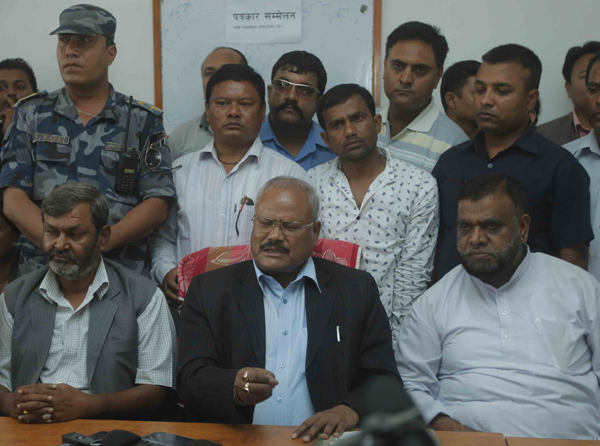
 MJF (D) Chair Bijay Gachhadar at a press conference in the Singha Darbar on Friday. Photo: Bikram Rai
Om Astha Rai
In a day of high political drama, the only Madhesi party that endorsed the 16-point deal, the blueprint for the new constitution, has disassociated itself from the four-party alliance.
The MJF (D), which signed the 16-point deal on 8 June and another follow up agreement on the six-province federalism model on 8 August, appears to have found it politically suicidal to keep backing the deal it struck with the NC, UML and the UCPN(M).
At a press meet in the Singha Darbar, the MJF (D) Chair Bijaya Gachhadar said, "We strongly condemn the seven-province federalism model that eliminate identity of the Tharus."
Gachhadar did not attend the meeting of a special committee formed by the Constituent Assembly (CA) on Friday. But the committee decided to replace the six-province federalism model with the new seven-province one without Gachhadar's consent. The province 2 of the previous model has now been divided into two separate provinces to create a Karnali province and Thori VDC of Parsa district has been shifted to the province 3.
A Tharu himself, Gachhadar appears to have found it politically untenable to back the seven-province model when Tharus, Madhesi and Janajati parties opposed to it have enforced an indefinite general strike in the plains. He has once again floated the idea of eight provinces model with a Tharuhat state comprising Kailali district too.
With the exit of the MJF (D), the ruling NC-UML coalition and the main opposition UCPN (M) will be isolated and their position further weakened. The MJF (D) has only 14 CA members and will not be able to stop the NC-UML-UCPN (M) alliance from passing the new constitution even if it forms a new alliance with other Madhesi parties, but its exit is likely to decrease the new constitution's acceptability.