

Chhori Maiya Maharjan went to meet Surakshya Singh in Baneswor on 28 February 2012, and was never seen again. It was later revealed that Singh owed Chhori Maiya Rs 5 million. An investigation by the Ministry of Home Affairs says Chhori Maiya was forcefully disappeared, and that there's strong evidence that Singh was involvement in the disappearance.
Yet, the Kathmandu District Court acquitted Surakshya Singh, aka Nikki, on 2 June. Family members say it is a flawed judgement and presents yet another example of a flawed justice system in Nepal. It's not just the judgment that's suspicious, family members say, the manner in which the court has conducted itself that has raised suspicions regarding the fairness in trial.
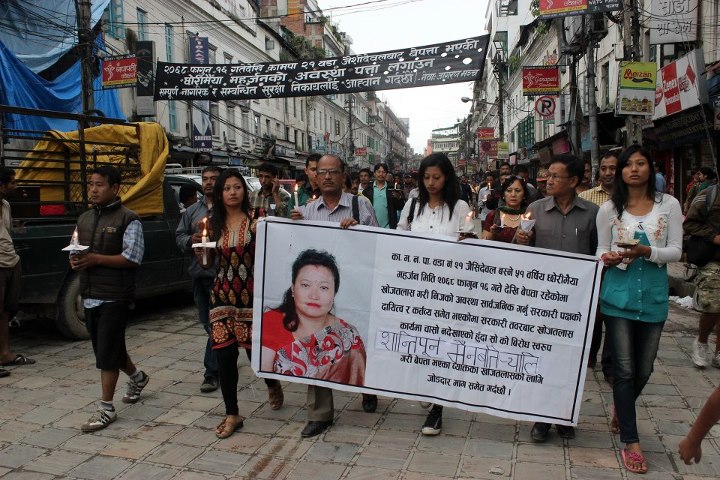 Chhori Maiya's family attend a rally demanding to know the truth about her whereabouts. (Pic: kidnappinginnepal.files.wordpress.com)
The court arrived at its decision at 9:50 pm and Judge Rajesh Kumar Kafle took 4 hours 50 minutes to write the verdict. In Nepal, the courts close at 5 pm. The judge took extra time to deliver the judgment outside normal working hours without permission from a higher court, and without any recorded reason to do so. For many this has raised suspicions that there was prejudice to acquit the suspect on the same day.
In his judgment, which was only a single sentence long, the judge merely said the accused was acquitted. There was no evaluation of evidence or reasoning. Legal experts say there were other irregularities. Any proceedings in a civilian court should be open to the public. The court has to function at officially approved times, unless it seeks permission to run its proceedings after office hours.
A one-line judgment, which fails to show ground for lack of evidence, puts the judge's actions in question and raises questions about whether the trial was fair. Whether the accused has been found guilty or acquitted, the judge should restate the evidence provided and arrive at a conclusion based on how this evidence establishes or fails to substantiate the charge.
Family members, however, cannot challenge the court irregularities fearing contempt action. Chhori Maiya's family was not provided a copy of the investigation report prepared by the Ministry of Home Affairs and were permitted to look at the report for only 15 minutes before the proceeding.
Before the judgement, Judge Kafle had deferred hearing dates on several occasions, confirming the view that in Nepal that the law doesn't favour victims and that justice is subject to money, power, and position. Chhori Maiya's family is distraught and say they want to keep pursuing the case until the truth is known, and also so others don't have to suffer like them.
Anil Karki