
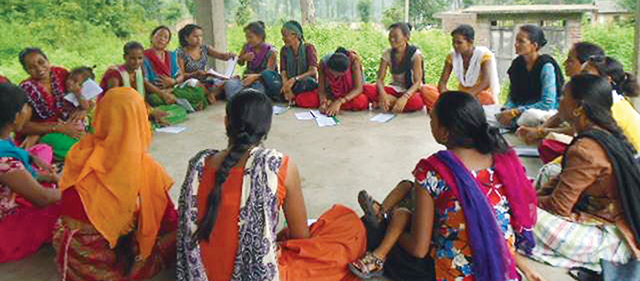
 Women in Gurvakot village of Surkhet take part in a meeting to choose candidates for local elections last week. Photo: Laxmi Bhandari
From the Nepali press
Himal Khabarpatrika, 23-29 April
Kamala BK is a candidate for the Gurvakot village council election in Surkhet. She has been a social activist, and says she is excited about joining local government after years of working with a non-government group.
Sita Devi BK is also standing as a ward council member, from Barahatal village. She also worked for a non-government group and predicts that little will change if she enters government. “I will be doing what I have been doing, struggle for gender rights, by standing in elections.”
Across Nepal, there are many women – most from minority groups like Dalits – who are going to have a chance at governing because of quotas for women candidates in local government units. Nepal’s first election under the new Constitution mandates that municipality and village councils must have a woman in at least the post of chair or vice-chair. The councils themselves should have at least two women members, of which at least one must be from the Dalit community. In Surkhet alone, the five municipalities and 99 wards will have at least 207 women; 99 will have to be Dalits.
In the Tarai, too, there was already considerable enthusiasm for local elections even before the Madhes-based parties decided to unite and take part in the second phase of polling. The interest is especially palpable among Dalits and women. Pasi Devi Rajbansi of Dhanpal village of Morang is standing for vice chair from the UML party. She says: “We are really excited. There is now a certainty that we will be represented in local government.”
Kala Devi Sah of Kathari village is from the NC and Devkala Yadav of Sunbarshi is standing for ward chair: both are actively campaigning door-to-door. Whatever their party affiliation, candidates’ campaign promises are all the same: education, health, jobs, better roads and no discrimination.
Sangita Darji, 38, is from the tailor caste and would be considered ‘untouchable’, but today she is standing for ward council member of Kamal village of Jhapa district, from the RPP, and has already started campaigning. Darji had actually decided to go to the Gulf to work as a domestic, but abandoned the process after hearing that it would be possible to stand in local elections. Kopila Nepali is also a Dalit from the same village. A member of the Maoist-Centre party came to her house to convince her to stand in the council election. She is not a member of the party and makes ends meet with a small tailoring shop, and money her husband sends home from the Gulf.
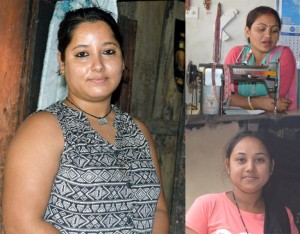 Dalit women candidates from Morang: Anita Thatal of the NC, Sangita Darji of the RPP, Kopila Nepali of the Maoist-Centre (from clockwise).