
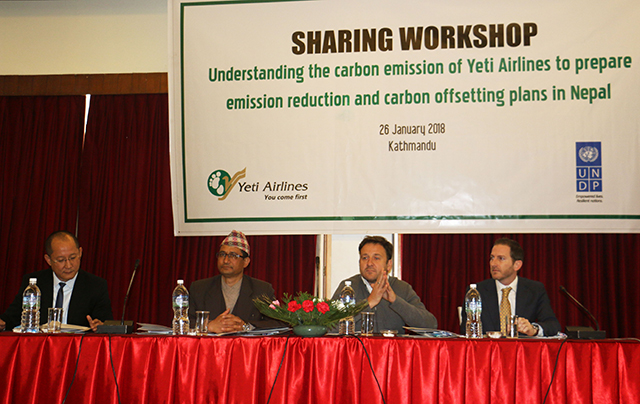
 Umesh Chandra Rai, CEO of Yeti Airlines,Director General of Civial Aviation Authority of Nepal Sanjeev Gautam, UNDP Nepal Country Director Renaud Meyer and Mitch Hall (left to right) in an event to mark Carbon Neutrality Partnership between Yeti Airlines and UNDP on Friday in Kathmandu. Pic: Yeti Airlines
Kunda Dixit
Yeti Airlines has become the first operator in Nepal to perform an energy audit and plan mitigation efforts to reduce its carbon footprint.
An fuel inventory of the company’s eight aircraft fleet, its 27 vehicles and offices around the country showed that the company generated just over 18,000 tons of CO2 equivalent last year. Yeti now hopes to increase efficiency by replacing its ageing with BAe Jetstream 41s with more modern ATR 72 500s, work with the civil aviation authorities to streamline air routes as well as offset its carbon use.
“As an airline we burn a lot of aviation gasoline, but there are ways to reduce emissions by being more fuel efficient and other measures that will not just make us climate friendly but will also save on costs,” says Yeti Airlines CEO Umesh Chandra Rai.
Yeti has been working with the United Nations Development Programme (UNDP) in Nepal to spread awareness about its Sustainable Development Goals (SDG) through decals on its aircraft, airside ramp buses, boarding passes and on other stationery. UNDP has been signing up the private sector to propagate its SDGs throughout the world and this week signed a similar carbon reduction agreement with China’s Hainan Airlines.