
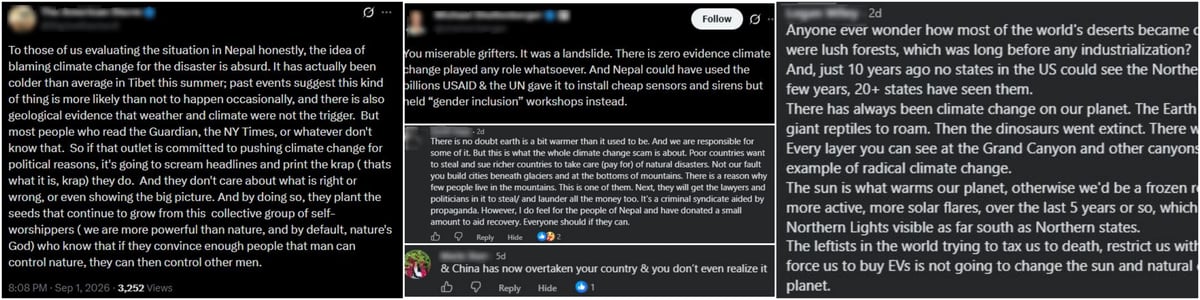
As Nepalis struggle to come to terms with the enormity of the catastrophic flood in the Trisuli Valley on 26 August, a parallel flood has been surging across social media platforms.
It has been 11 days of a digital deluge of opinions, accusations, false claims, and some attention-seeking performative outrage. Scientists have yet to piece together the exact sequence of what caused the devastating debris flow, yet many ‘experts’ have already delivered their verdicts via social media.
There is also hostility toward scientists, trolling by climate deniers, partisan insults and geopolitical abuse. ‘Academics are useless’, ‘We need action, not ideas’, ‘Experts only talk’, ‘Scientists create a climate of fear’ are some of the more polite comments.
Such statements generate ‘likes’ because they channel public frustration amidst a tragic and chaotic situation where some need someone to blame.
Social media itself is not at fault. In fact, given Nepal’s terrain where geography often limits communication and state institutions cannot be everywhere at once, social media has become an essential disaster-response tool.
It helps families locate loved ones, communities share warnings, volunteers mobilise relief, and citizens document unfolding events. During emergencies, information can save lives.
But algorithm-driven outrage also shows a misunderstanding of how societies confront risk and scientists communicate their findings and ideas in public. While these trends are not unique to Nepal or any other disaster hit areas, it also raises a fundamental question of how researchers should engage in scientific communication.
The Himalaya is a young, geologically active mountain system where ecological, geological, climatic, and social processes interact in ways that are extraordinarily difficult to predict. It is almost impossible to assess and monitor all possible hazards and disasters. What happens in the mountains can trigger consequences downstream with little warning.
DARK SIDE
But this disaster also revealed social media's darker side. The Nepal-China should remind us that nature is often more complex than our explanations. Early evidence suggests a complex, cascading chain of events involving slope failure and a detached glacier.
This rock-ice mass slid down the steep slope collecting debris and sediments along the way and then gaining even more energy and creating a fast-moving tsunami-like catastrophic flood. Scientists are still reconstructing exactly what happened, and there is still considerable uncertainty about the details. Solid explanations that take time.
But the cybersphere does not like uncertainty. Social media platforms reward people who sound sure of themselves, not people who admit what they do not know. The person declaring they already know the cause of the disaster will often attract more attention than the scientist carefully evaluating competing explanations.
Nuance is mistaken for weakness. Doubt is interpreted as incompetence. A complex socio-ecological crisis is then reduced to a slogan.
The most disturbing feature of social media engagement is the transformation of tragedy into entertainment even more than earlier legacy tabloid press.
A catastrophe is turned into ‘content’. An ice-rock avalanche becomes content. Human suffering becomes content. Comment sections fill with mockery, outrage, conspiracy theories, and political point-scoring -- all while families mourn their losses.
Videos of destruction are consumed with the same casual detachment as any other viral post. The algorithm favours emotional reaction, not ethical reflection. The result is a public sphere that is often disconnected from empathy.
Behind every image of a destroyed bridge lies a disrupted community. Behind every casualty statistic is a family navigating grief. Behind every flood map are people whose lives have been permanently altered.
Yet society must recognise the complex nature of this disaster, and its response management cannot be fully taught in disciplinary areas — it requires collaboration and systems level thinking. Scientist cannot be rushed into giving a definite answer for more effective policy interventions and reconstruction efforts.
Meaningful action is not possible without knowledge. Flood forecasting, hazard mapping, disaster monitoring and modelling, resilient infrastructure design, and early warning systems all originate in years, often decades, of scientific inquiry.
Every infrastructure built in flood prone areas, every evacuation plan, every risk assessment, and every adaptation strategy must begin as research long before being implemented. Society needs both action and ideas. It needs rescuers on the ground and researchers in the field.
It needs both immediate relief and long-term understanding. The real challenge is to bridge these competing demands more effectively.
Science helps us understand hazards. Society determines how people perceive and respond to its warnings. Governance connects the two by turning knowledge into action through preparedness, infrastructure, education, and cooperation.
In the Himalaya, many hazards cannot be prevented due to its unique bio-geophysical characteristics that set off earthquakes, seasonal landslides and floods. But with stronger links between science, society, and governance, their impact can be greatly reduced.
Those of us in academia and applied research should also view disasters as a moment for reflection rather than rushing to social media without strong evidence just to compete for attention, speculating beyond available evidence, or, in some extreme cases, turning tragedy into personal branding opportunities.
The pressure to provide instant answers can undermine the very principles that make expertise valuable in the first place.
Academic integrity demands patience. Research ethics require humility. When evidence is incomplete, researchers should be willing to say, "We do not know yet." When uncertainty exists, it should be communicated honestly rather than concealed beneath overly confident statements.
In a disaster, the role of scholars is not to win online arguments or collect followers. It is to provide careful analysis, acknowledge the limits to what we know, distinguish evidence from speculation, and contribute to collective learning.
This responsibility is particularly important in Nepal's incredibly complex bio-socio-ecological context. Disasters happen in the context of glaciers, rivers, sediments, infrastructure, climate variability, and human settlements. The complexity of these ever-changing, interconnected systems means that premature conclusions can be misleading. Responsible scholarship requires evidence before judgment.
Nepal and the wider Himalayan region and other disaster-prone areas need a different disaster conversation. One that values evidence over virality, humility over certainty, and understanding over outrage. Citizens should be free to question institutions, but criticism should not become contempt for knowledge itself.
Milan Shrestha, PhD is with the School of Sustainability, Arizona State University in the United States.