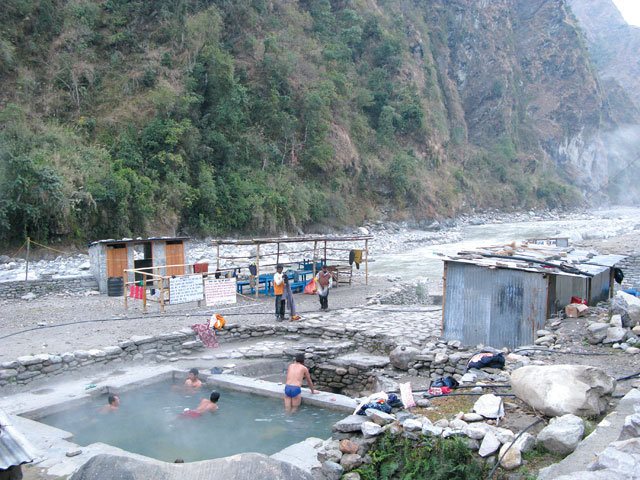
When the Indian and Eurasian plates collided violently starting 40 million years ago, it not only gave Nepal the world’s youngest mountain range but also a string of hot springs right across the country from east to west.
Nearly all of these hot springs lie close to and north of the Main Central Thrust (the main fault line along where the Indian Plate pushes user the Eruasian one) and the south of the Main Boundary Fault (the line separating the Siwalik from the older rocks to the north).
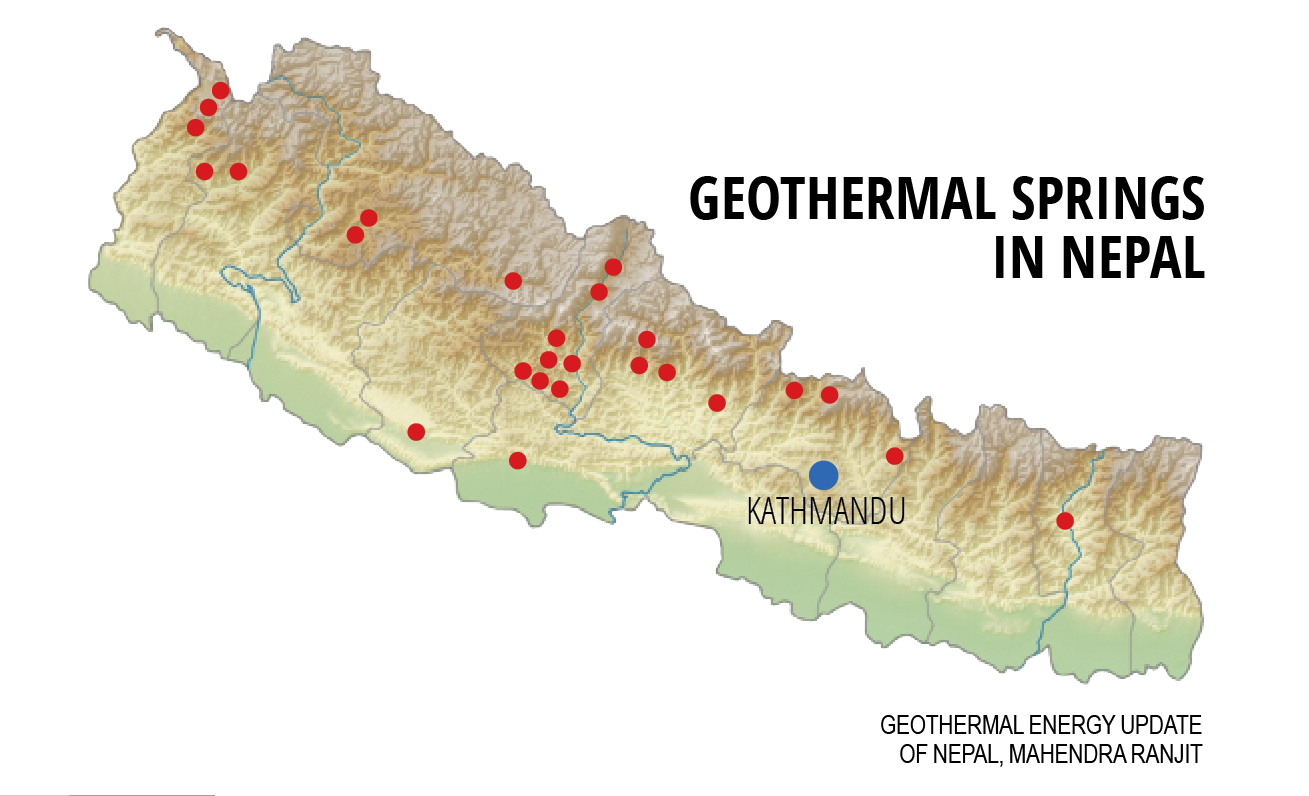
The same geological reason Nepal has frequent earthquakes is also what gives the country almost all its known geothermal springs (see map).
Nearly all houses in Iceland are heated with geothermal energy, but Japan has not allowed geothermal electricity generation because of fears it will affect its onsen hot springs. Nepal, however, has still not been able to fully exploit hot springs, neither for health nor energy.
Nepalis have traditionally used hot springs for balneotherapy, dipping in the steaming waters to treat everything from skin disease to arthritis, not enough has been to study the potential for geothermal energy. A detailed location of known hot springs and their energy potential are hard to come by.
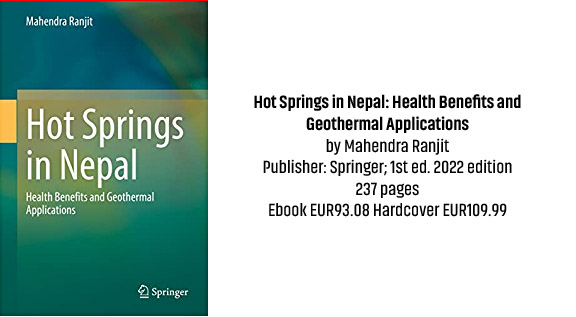
Now, the new book Hot Springs in Nepal: Health Benefits and Geothermal Applications by geothermal researcher and renewable energy consultant Mahendra Ranjit looks to change that. The book gives readers a general idea of geothermal springs in Nepal and the medicinal and socio-cultural values of these sites. Ranjit even looks at the use of geothermal water for electricity generation, industrial applications and geo-cooling.
Most thermal springs in Nepal are located very close to the Main Central Thrust or the Main Boundary Fault with heat flow within the global mean range (60-80 mW/m2), meaning that the heat acting on the spring water is likely to be of tectonic origin. A hydro-geological investigation in the Kali Gandaki area indicated that in the Nepal Himalaya, the surface water seeps deep beneath the ground and gets heated due to the high temperature before rising to the surface along the fractures.
Hot springs along the length of the Himalaya in 21 of 77 districts have a spa-like temperatures, and only two springs have water as hot as 80C. This means most hot springs in Nepal are ideal for spa resorts if properly developed.