
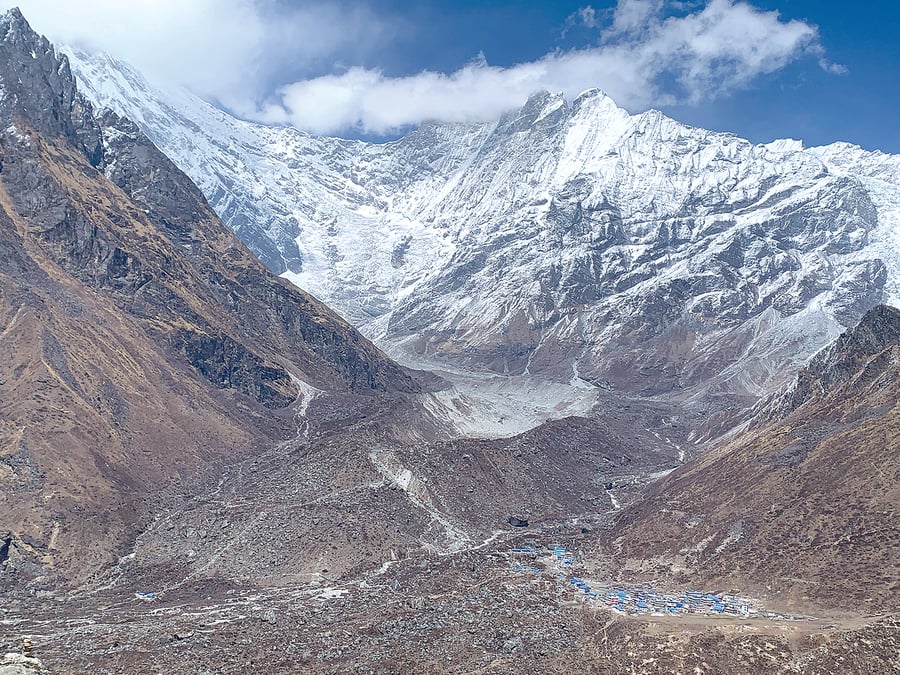
Data centres have become a contentious subject in policy debates worldwide, and even in Nepal some experts speak of data centres as if it is the next gold rush.
“Bring Facebook data centres to Nepal, and then we can localise our own data, for data sovereignty,” said one expert recently in a chandelier-lit conference room at a Pulchok hotel.
The pitch is usually framed as a win-win: data centres get cooled naturally in the Himalaya, and Nepal’s economy can get a boost with talent, money, and leverage that big tech brings. The country’s hydropower potential would power this imagination, offering the promise of clean, cheap energy to match the cold, clean air.
The same promise of cold temperature and abundant renewable energy once drew data centres to geothermal energy-rich Iceland. In her ethnography Where Cloud is Ground, Alix Johnson writes that although technology is often imagined in opposition to the natural world, as something that subdues or escapes it, digital infrastructure is in fact deeply entangled in ecological narratives.
Data, she writes, was drawn to Iceland not simply by the availability of natural resources, but by the deliberate work of marketing those resources: landscapes turned into pitch decks, cultural history turned into a selling point. The ‘natural fit’ was, in large part, a story told before data centres were built.
It is the same rationale now in Kathmandu’s ICT circles. Nepal may well succeed in bringing data centres to the Himalaya, and construction could bring an initial burst of jobs. But the data centre business only really works at scale, and scale is where the costs start to show.
Felipe Figueiredo, a PhD candidate at the IT University in Copenhagen, researching data centres in Iceland, points out that the business model underneath all this is essentially rental infrastructure, connectivity, energy, cooling, and on-demand computation, leased out not just to serve society but mainly to generate profit for tech companies.
“Data centres are critical infrastructure,” Figueiredo says, “but not all the compute that happens in commercial data centres is critical for society.” A great deal of it is cryptocurrency mining, or AI slop, consuming more electricity than the databases running hospitals, schools, and universities, or the basic infrastructure of everyday communication.
Figueiredo argues that the surveillance-driven business model of social media, the mass collection of personal data, is itself a form of computing that has no place in a genuinely sustainable data centre.
European civil society is currently grappling with legislation that, according to journalist Nico Schmidt in a podcast with Tech Policy Press, was drafted verbatim from a Microsoft lobby document, with only a typo corrected in the final version.
Besides proposing what Key Performance Indicators are relevant, they also proposed that those KPI of energy use of data centres be shielded from public scrutiny by law. What is built, how much it consumes, what it emits: under this framing, none of it is meant to be our business.
This opacity, and an appetite for resources that treats machines as more entitled than people, runs through how US big tech approaches infrastructure. At India’s AI Impact Summit earlier this year, OpenAI CEO Sam Altman was pressed on the electricity demands of AI.
His response was to compare it to the food a human being eats for over 20 years before joining the workforce. The industry equates machine consumption with human need. OpenAI is currently eyeing data centre commitments of roughly $1.4 trillion over the next eight years.
Energy availability is, in practice, the hard ceiling on how far this industry can expand, and the scramble for it is already reshaping who gets power and who does not. Here in the Netherlands, where I am now, data centres currently consume up to 4.6% of total electricity, equivalent to the annual usage of two million households.
That boom has caused grid congestion severe enough to stall new housing construction in a country already facing a housing crisis. Figueiredo calls this ‘grid grabbing’ -- private corporations buying up future electricity in advance from public utilities, securing capacity the state has not even built yet.
It is a way of privatising a public resource that could potentially be used for improving local infrastructure and household access to electricity, and it puts direct pressure on local grids.
Kenya offers a starker version of the same story. President William Ruto has stalled a billion-dollar Microsoft data centre project, initially expected to break ground in May 2026. Kenya’s installed capacity currently stands at 3,000MW, and the proposed data centre alone would have needed roughly a third of that. The project was announced in 2024, during Ruto’s visit to Washington, framed at the time as a way to deepen US-Kenya ties.
LESSONS FOR NEPAL
Kenya’s experience raises an uncomfortable question for Nepal’s own relationship with China. What would it mean if data centres owned by big American tech firms now operating alongside the US government, especially when much of the hydropower Nepal is offering runs on Chinese investment and technology?
Bichuten Data Vault, marketed as a step toward a ‘digitally sovereign’ Nepal, wants to build a tier-4 hyperscale data centre that could consume 100–500MW on its own. Meanwhile, as of 2023, 6% of Nepal’s population (over 1.5 million people) had no access to electricity at all.

Before we chase the dream of becoming the Himalayan hub in someone else’s cloud, it is worth asking a much simpler question: is it fair to divert scarce electricity toward data centres in a country that has not yet managed to light every home?
Ayusha Chalise is a communication and development scholar specialising in how politics is experienced in the digital space. She contributes this Cyberia column for Nepali Times.
Where Cloud Is Ground
Placing Data and Making Place in Iceland
by Alix Johnson
University of California Press, 2023
$29.95