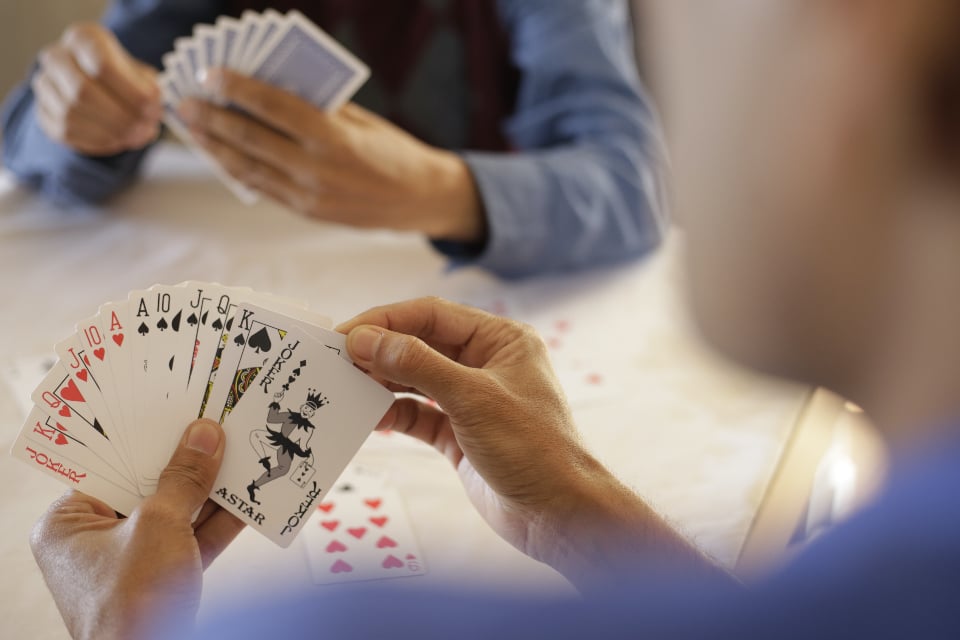
When the cowrie shells come out in Kathmandu's courtyards during Tihar, few players know that more than 170 years ago, rulers of the day codified gambling into law. Today, engaging in games of kauda and langur burja during festivals is not legal, merely tolerated.
Foreign visitors loved to moralise about Nepal’s gambling culture. William Brook Northey, in his 1937 book The Land of the Gurkhas, called Nepalis 'certainly inordinately addicted' to gambling, and wrote that 'upon the beat of a drum…the whole population gives itself up forthwith to its one all-absorbing passion'. His book has accounts of men who staked 'their wives and children on a throw of the dice'.
That is colonial caricature. Yet, as historian Simon Cubelic notes in a 2018 study of Rana-era gambling, the complaint that gambling was ruining ordinary people’s lives dates well back to the nineteenth century. King Surendra's copper-plate decree of 1855, for instance, justified strict controls because gambnling left people poor and indebted by the dice.
After conquering the Valley, Prithvi Narayan Shah, in keeping with the Brahmanical idea of kingship, banned gambling outright. The Manusmriti edict calls gambling and betting 'open theft' that a king must work constantly to eradicate.
Rana Bahadur Shah reversed course in 1798, legalising gambling during Tij, and eventually during Tihar. For decades after that, the rules varied from region to region.
Jang Bahadur Rana's Mulukī Ain of 1854, swept away that patchwork. The national code’s chapter ‘On Gambling’, runs to 16 sections. The key one is blunt: 'Within the entire Gorkhā realm from now onwards, the players may gamble every year for 5 days of the Yamapañcaka festival … They shall not be held accountable. No one shall play before or after.”
The window was opened publicly, "by proclamation with sounding cymbals”, and closed the same way. The code also licensed gambling two days and two nights at Pachali Ghat for Krishna Janmashtami, at Tundikhel for Chaite Dasain, and at Mrigasthali in the Nepali month of Kartik.
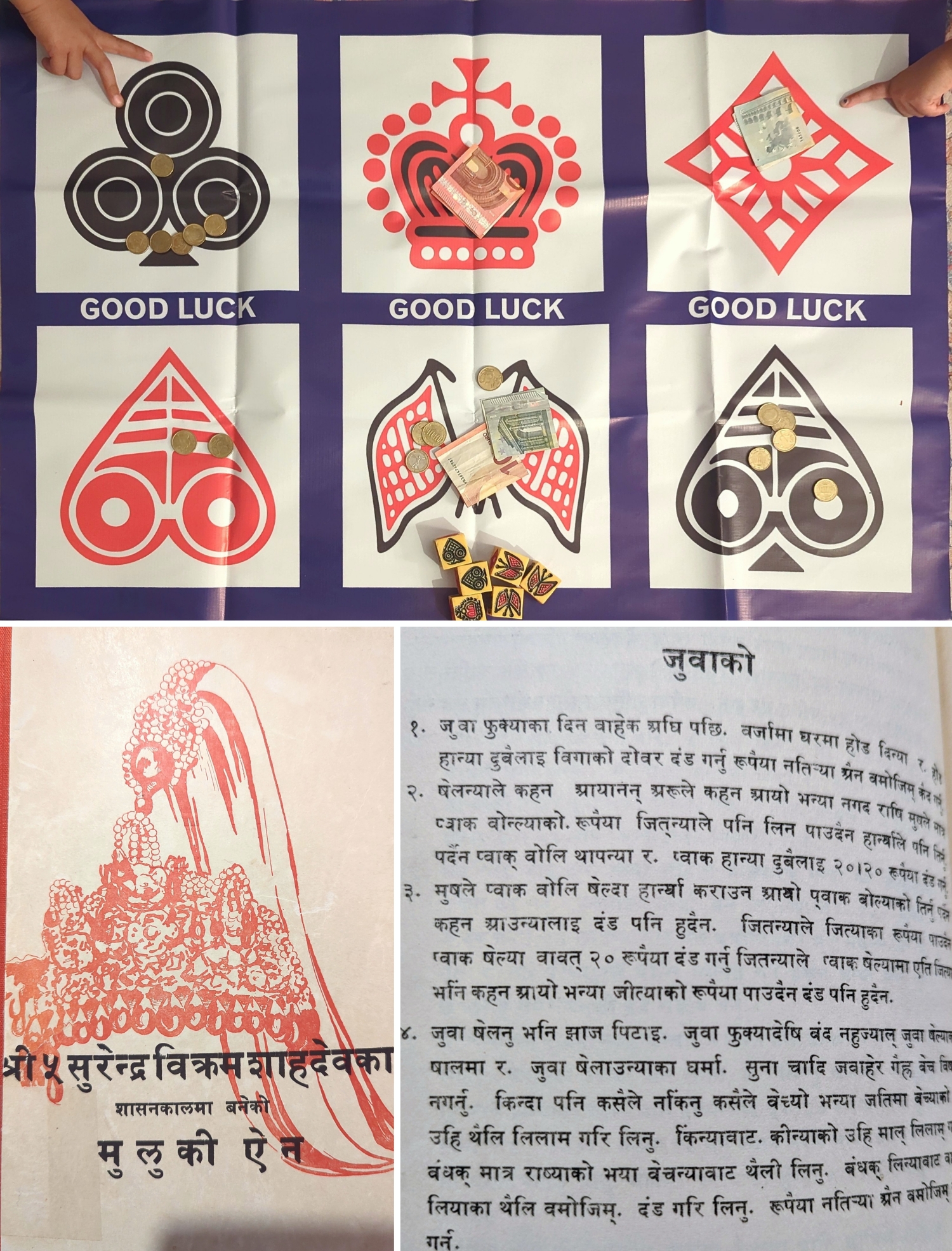
What stands out is how carefully the law tried to stop people betting away everything. Stakes had to be coins. No one could bet ‘jewellery, clothes, vessels, valuables, weapons, cows, water buffalos, persons or the like’. That is a sharp reply, written 80 years early, to Northey's tale of men betting wives and children on the dice.
Additionally, lending money at the gambling venue was banned, and so was selling gold there. Anyone caught rigging ‘dice, cowries or other throwable objects’ had to return the winnings and pay a fine of the same amount.
Illegal gambling was strictly punished. A landholder or professional caught at it could choose between losing his share of property or two and a half years in prison. The code was gentler with children: those under 12 caught playing okhara for money were simply to 'be scolded and told that they should not play and be let off'.
HOUSE WINS
The law tells us what the state wanted. Meanwhile, Cubelic’s academic exploration titled Studies in Historical Documents from Nepal and India, uses five archival documents from 1902 to show what it actually did.
By then, the Mulukī Ain had been revised several times, and Cubelic reads the documents against the amended edition of 1888, the one closest in time to his case. His subject is the gambling licence for the market square around the Annapurna temple in Asan, on land that belonged to the Guthi.
The licence was not a favour. Under the 1888 code’s rules on revenue arrangements, it was a revenue farm, or ijara, auctioned like a forest or a customs post. Gambling there, Cubelic writes, 'was treated as a franchise under a state monopoly, which controlled it as a source of revenue in the same way as the exploitation of land or natural resources was licensed according to a tender process.'
The paperwork reads like a small thriller. Meheraman Nhuche Pradhan bid 35 mohar rupees a year. A rival, Krishnavir, topped him by two. Meheraman went three better and won at 40. When the final one-day notice blew away in the wind, three witnesses had to swear in writing that it had been posted.
Then a latecomer, Kularatna, petitioned. He had missed the deadline, he said, because he had to attend a death ceremony. The Commander-in-Chief let him in and ordered a live auction, since Dasain was close to the legalised gambling days. The two men bid against each other until Kularatna won at 84 mohar rupees a year, which was 'more than double the amount of the first tender'.
Cubelic sums up the Rana approach in three aims: 'first, to accommodate an established socio-ritual practice; second, to maintain social order; and third, to generate income for the state." The Ranas did not just tolerate the game. They ran the house, and they made sure the house won.
Almost two centuries later, gambling is illegal for Nepalis, and citizens are barred from Nepal’s casinos that are licensed for foreigners. Yet every Tihar the cowries and langur burja boards come out again. Families play at home, friends gather in groups, and many participate in quietly organised sessions.
Officially these are festival games, and there are supposed to be no stakes. Everyone knows otherwise. Money is what makes the game fun, and the stakes range from a few coins at a family table to very large sums in secretly organised rounds.
Household and friendly games are largely tolerated, while large organised gambling still risks a police raid. But while the law might ban it, custom keeps the practice alive.
That grey zone is the old pull between custom, order and revenue in a new form. The 1854 code was at least honest about this. It named the days, the places, the coins that could be staked and the punishments for cheats. It protected families from ruin, and it said plainly that the state would profit.
But Cubelic ends with a question that is still relevant: When a petition and a word from the top could override the rules, was the state listening to its people, or was it free to bend the law as it pleased? Anyone who has followed how casino licences are handed out in Kathmandu today will find that question apt.
This Tihar, as the cowries fall, it is worth remembering who first drew up the rules of the game.
Rajan Khatiwoda is co-director of the Nepal Heritage Documentation Project at Heidelberg University in cooperation with the Department of Archaeology, Nepal, and the Saraf Foundation.