

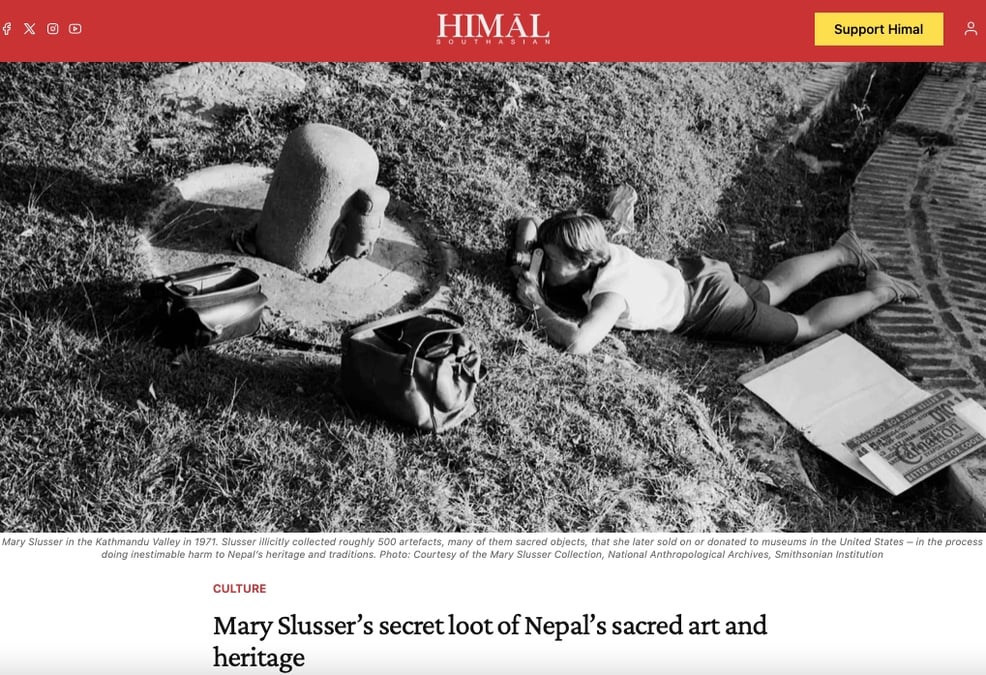
On 16 September, Nepal’s cybersphere woke up rattled and divided after an explosive investigation in Himal Southasian by Erin L. Thompson exposing the deeply compromised legacy of American scholar and Nepal expert Mary Shepherd Slusser.
The piece forced Nepalis, expatriates and the art world to confront an uncomfortable truth about the scholars who have written the history of Nepal’s heritage, and the extractive systems they upheld.
When criminologists Emiline Smith and Erin L Thompson published their paper, A Case Study of Academic Facilitation of the Global Illicit Trade in Cultural Objects: Mary Slusser in Nepal, in the International Journal of Cultural Property in 2023, it ignited fierce conversation, mostly inside academia.
That initial critique was met with swift institutional resistance, most notably from scholar Charles Ramble, whose response, “Is cancel culture coming to Himalayan Studies? Remarks on a recent critique of the life and work of Mary Shepherd Slusser,” appeared in the European Bulletin of Himalayan Research (#61, 2023).
But while Smith and Thompson’s findings were compelling, the broader discourse was still nascent — far too early for Ramble’s defensive attempts to shield the old guard.
We saw this dynamic play out firsthand in late 2020, when the Nepal Heritage Recovery Campaign (NHRC) was working on a recovered shalabhanjika traced to Ratneswor Temple in Patan’s Sulima.
In 2001, Slusser informed the Art Gallery of New South Wales (NSW) in Australia that she had 1969 photographs of the stolen artefact. Her response was astounding in its paternalism: citing subsequent thefts of modern reproductions at the temple.
She declared that the strut ‘had best be left on loan to Australia’. It was never Slusser’s prerogative to decide this on Nepal’s behalf. By appointing herself gatekeeper, she effectively overrode the community’s sovereign right to choose.
Thankfully, after extensive mediation, the NSW Gallery sent the strut back home in 2023. It was this case that first formed my own doubts about Mary Slusser.
Connecting the dots led me to the digital catalog of the Virginia Museum of Fine Arts (VMFA), an institution intimately tied to her legacy. There were a surprising number of objects from Nepal well over 100 years old.
It forced an obvious question: Nepal’s Ancient Monuments Preservation Act was formalised in 1956 and the legal framework explicitly protecting antiquities from export was already active when Slusser was living and collecting in Nepal in the 1960s onwards.
How did she bypass the law and secure permission to take all of these out of the country? I reached out to Thompson in mid‑2021, and later, when we met in person during the return of Lakshmi‑Narayan in Patko Tole, I showed her the collection on my phone.
That connection led to a revealing 2021 email exchange concerning a 16th‑century Buddhist scroll painting from Yampi Bihar (I‑bahi) in Patan, now in the VMFA. Slusser first encountered and photographed the work in 1967 and later played a key role in its acquisition by the museum, framing her intervention as ‘rescuing’ it from deterioration — a rationale she often used for countless objects she helped move out of Nepal.
Slusser was a remarkable scholar with a deep affection for Nepal, but she consistently took the country, its people, and its legal frameworks for granted.
The reaction online to the Himal Southasian expose has been predictably polarised. Many argue she should be remembered strictly for her contributions, that she stepped in to document what we were neglecting, and without her, we would have lost even the memory of these objects.
Slusser’s legacy demands that we hold two conflicting truths at once: she produced indispensable scholarship foundational to understanding the Kathmandu Valley, yet she was deliberately complicit in the plunder of its cultural heritage.
To canonise her solely as a saviour validates an extractive history. To dismiss her entirely ignores the local complicity that left our temple doors unlocked in the first place.
Slusser undoubtedly had a saviour complex. We were left with a situation where the very person who painstakingly documented our deities was complicit in their theft.
But accountability goes both ways: the Nepali state must also take responsibility for a crisis rooted in decades of weak institutions and low heritage literacy. We internalised a colonial mindset that elevated foreign experts to infallible, god‑like status, handing them the power to negotiate even the fate of our gods and goddesses.
Nepal was never formally colonised, yet it experienced colonial‑like dynamics. An intellectual imperialism in which foreign scholars claimed authority over local knowledge, wrote our history, named our gods, and decided what was ‘art’ and what was an ‘idol’, often without consulting the communities who still worship the figures.
Their archives became weapons of power: whoever kept the records got to decide what was real, who owned it, and what it was worth.
Perhaps the biggest lesson from the Slusser expose is that boundaries are imperative and sensitivity is non‑negotiable: scholars, tourists, dealers, and collectors must recognise where their curiosity ends and our sovereignty begins, asking who has the right to speak for a community, who benefits from an acquisition, and what harm is caused when objects are removed from their living contexts.
If future researchers and institutions take nothing else from this moment, they must take this: respect our laws, our rituals, and our right to say no.
Slusser died in 2017, but her archives remain. Her detailed documentation is a clear call for Nepalis to respect, reclaim, and fight for their heritage. Slusser can no longer defend herself, but it was she who chose to make her life and work public, and in doing so, left behind not just a legacy of extraction, but also a roadmap making restorative justice possible.
The central question now is how Nepal chooses to contextualise her complicated legacy. The ultimate check and balance against this extractive history is reinstallation, the physical and spiritual return of these deities to their original shrines.
While Slusser’s case has ignited the current reckoning, it is essential to recognise that she is part of a broader network of complicity. Other dealers, scholars, institutions, and intermediaries — both in the West and within Nepal, were either directly involved in similar thefts, or did not speak against what they knew was happening.
The investigation must go beyond Mary Slusser. Those who facilitated, benefited from, or enabled the removal of Nepal’s cultural heritage must also be implicated. This is not about scapegoating one individual, it is dismantling a system that allowed such practices to flourish for decades.
Erin Thompson’s piece is essential reading for a world finally ready to look at the facts without flinching. Given my involvement in Thompson’s investigation, I attempted to track down the dealers, middlemen, and thieves in Kathmandu involved in these early networks that Slusser mentioned in her archives.
I hit a wall of silence: most original perpetrators have passed away, many families have left the field entirely, and those still involved are reluctant to speak, creating a paradox where greater public literacy on illicit trafficking only drives remaining enablers deeper into the shadows.
For too long, Slusser gatekept our cultural heritage, deciding what Nepal could have and what it must leave behind. But the investigation now has the ball in Nepal’s court. We can now make decisions for our own ownership, using her archives, as evidence to assert our rights, reclaim our deities, and write our own heritage narrative.
In the wake of our country’s recent catastrophic floods, it is natural to ask where cultural heritage fits amidst immediate survival needs. When homes are washed away and lives are upended, advocating for stone and wood can feel disconnected from the reality of disaster.
Yet, the preservation of our history is closely tied to community resilience. When the physical environment is devastated, the shared memory, rituals, and tangible anchors of our identity ensure our communities endure through times of crisis. Protecting what remains of our heritage, and fighting relentlessly for what was stolen, is how we honour what has been lost.
Heritage reclamation is labour‑intensive work: inventorying collections, tracing provenance, negotiating with museums, preparing legal dossiers, coordinating logistics, and managing reinstallation. This cannot be done by overworked and understaffed Department of Archaeology (DoA) and practitioners, it requires a sustainable, institutional plan led by the state.
That plan must include a dedicated repatriation unit within the Ministry of Culture or DoA, with clear mandates and protocols, systematic training and exposure for bureaucrats on international repatriation frameworks and negotiation tactics; and ring‑fenced financing to support long‑term field inventories, legal research, diplomatic travel, and public heritage literacy campaigns.
Without skilled, motivated bureaucrats and reliable budgets, even the best‑intentioned policies will stall. Heritage recovery is not a one‑off press event when the deities are returned to Nepal, it is a marathon of paperwork, diplomacy, and community engagement. The state must fund it, not just applaud from the sidelines.
The responsibility to protect our narrative, in all its complex and grey truths, now belongs entirely to us. Slusser’s archives in Nepali hands become evidence to trace and demand back the gods that were taken from us.
Alisha Sijapati is a writer and cultural heritage practitioner.