
 ANURAG ACHARYA |
Being a journalist in this country has its moments. You hobnob among Kathmandu's power elite, you get to see up close just how narrow their world is and how it is defined by one-upmanship.
And what a contrast it is when you then travel to Nepal's outback mired in its dusty, grimy poverty, and see the stark difference between daily lives of the rulers and the ruled.
And that is also where you experience the glaring disconnect between the obsession of capital-centric national media and the everyday concerns of rural Nepalis. This contradiction has seeped into the public consciousness.
In the oppressive heat of the Tarai summer in Lahan last week I approached an elderly man in a tea shop. "Go back to Kathmandu and talk to your netas," he told me gruffly, "don't pretend you need my opinion, as if it matters."
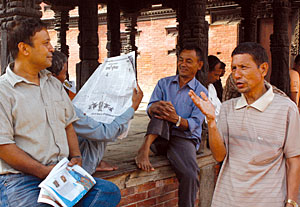
The people are so fed up with political posturing and slogans that they are now blaming the messengers, the media, for giving so much space to them. They also think the media is partisan, dominated by biased opinions, and driving a wedge between Nepalis instead of pulling them together.
Recently a newspaper published a list of journalists and editors who had 'sold out' to the ruling coalition partners, the Maoists and the Madhesis. The news also stated that the Nepali Congress is now preparing to 'buy' its own media house. It is hard to say which is more absurd: a newspaper printing a list of 'pro-government' editors, or the Kangresis thinking they need a media house to lift their sagging fortunes.
Indeed, editorial positions have hardened as the stakes get higher in the political vacuum left by the dissolution of the CA. Editorials and prime time news sound like smear campaigns between the rivals. The corporate media is openly taking sides depending on their business and political stakes, viewers and readers are subjected to stilted and barely-concealed propaganda.
Last week, there was a Panchayat-style warning to a tv station from the Ministry of Information (under direct orders from the PMO) for daring to broadcast news critical of the government.
But the threat to press freedom does not only stem from the state or from commercial interests beholden to politicians, eroding journalistic ethic among the messengers is equally to blame. Into this throw is a society that is now polarised by ethnicity, where a volatile mixture of hate speech, outright racism and maliced opinions are taking precedence over journalism.