|
|
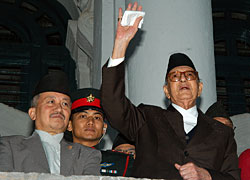
Last year, anticipation was in the air as we wondered whether the king would show up or not. Of course in the end he did, and as he stood on the balcony of the Gaddi Baithak, he looked confident, arrogant, even happy, in spite of the boycott by most foreign diplomats.
This year, the same anticipation. Would this be the first time in the 250 year history of the Kumari Rath Jatra, that the festival would not be presided over by a monarch? Even till 3.30 PM no one seemed sure. In the end Girija Koirala did show up, but disappeared at the crucial time.
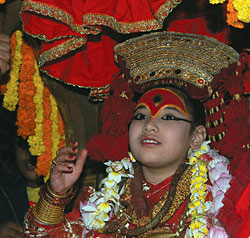
Inside Kumari Ghar everyone was so taken up with preparations for the 250th anniversary of Kumari Jatra, that the question of who would preside did not seem very important. "That's just politics. It doesn't concern us," one of the Kumari guardians said.
During the early and mid-eighties, we never missed the first day. To make sure we got a good vantage point, we would be sitting on the steps of the Narayan Temple (which nowadays is reserved for the massive press corps, rather unfairly keeping Kumari's biggest fans at a distance) from about 2PM, though the king would not arrive until after four and the chariot pulling would not begin until after five.
King Birendra was still an absolute monarch. While he was not popular among urban, educated youth, anything like an anti-monarchy demonstration would have been unthinkable. The monarch was simply there, and politics were forgotten at festival time.
An unforgettable feature of the festival in those days was the brutal crowd control that would begin about an hour before the king's arrival. With typical cheerful Nepali anarchy and amnesia (it happened every year) people would crowd into the square in front of the Gaddi Baithak, only to be beaten back, sometimes quite viciously, to make room for the military bands, the Newar dancers, and the king's motorcade. Even more striking was that no one actually seemed to mind. No one ever fought back, and people even smiled and laughed as they held their aching heads as if it was all part of the fun.
Not last year. Just about the time the onlookers were eventually persuaded to leave the square, a noisy crowd of Maoist anti-royalists tried to force their way in from the direction of Kasthamandap and were beaten back with the old enthusiasm. Meanwhile, in front of the king there was a small flag-waving, pro-royalist demonstration. This year it was the pro-royalist black-flag demonstration that was kept out, giving the riot police their one opportunity to wield their truncheons and make a few arrests.
 |
Also kept out, for some reason, were the dancers. Did the prime minister not wish to appear to be stepping directly into the king's footsteps? Lakhe and Bhairav had spun around enthusiastically in return for royal coins last year. Lakhe now put in an appearance just long enough to slip and fall. Bhairav and his followers literally had to fight their way into the square, then danced listlessly off to the side. Indra's elephant, a great crowd pleaser, was nowhere to be seen, at least not yet. Just before Ganesh, Bhairav and Kumari emerged, when festivities should have been reaching a fever pitch, the square went eerily quiet.
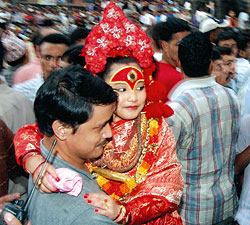
When the chariot procession started, things got very strange. The prime minister stood there smiling and waving, among far more ambassadors and far less military brass than had been present last year, as Ganesh and Bhairav stopped in front of him. Then, before Kumari's chariot approached, he went inside, followed by his ministers. At this point, an axle on Kumari's rath broke. I've seen her stuck in all sorts of potholes in the back streets, and I even remember seeing her carried home while her chariot was left to be retrieved the next day. But I have never seen her stuck before she even started.