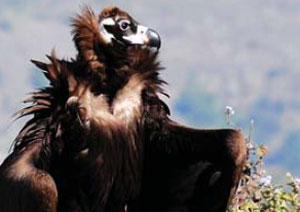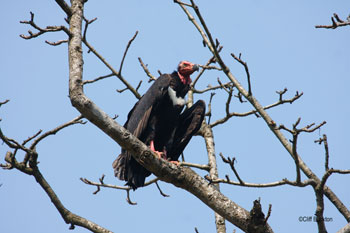
The nest, as a group of ornithologists from Animal Rights Nepal, consisting of Krishna Mani Baral, Hemanta Dhakal and Tek Narayan Bhattarai, later confirmed, belonged to a pair of red headed vultures, the first recorded sighting of the nests in Nepal. For the past year, the team has been studying the behavioural patterns and recording the activities of the two birds through binoculars and digital cameras. Recently, the experts noticed a different pair of vultures using the same nest which has led them to believe that a significant number of red-headed vultures maybe present in the area.
Locally called soon giddha, the species was historically abundant and found widely across the Indian Subcontinent. However, in recent decades, as with other species of vultures, a sharp decline in its numbers has been reported. There is no record of nest of Red-headed vulture till 2012 in Nepal. Their numbers have been recorded during carcass feed, roosting and flight only. In countries like Singapore and China where they were found in large quantities only 30-40 years ago, the red-headed vultures are now extinct.
Among the seven species of vultures found in Nepal, three (oriental white-backed, long-billed, and slender-billed) are listed in the critically endangered list of International Union for Conservation of Nature, the oldest and largest global environmental organisation.
"As the discovery of nest of soon giddha in Nepal will lead to greater developments in vulture conservation efforts in the country,” says Krishna Mani Baral, an ornithologist with the Animal Rights Nepal team.
Conservation work across the region intensified since 2004 when India, Bangladesh, Pakistan, and Nepal agreed on the ‘Kathmandu declaration’ and pledged to ban the use of diclofenac, a veterinary steroid commonly used to treat livestock, which was determined as the main cause of death among the birds. In 2006, the Nepali government also imposed a ban on the manufacturing, sale, and import of the drug. As a supplement to the banned diclofenac, the government permitted the use of Meloxicam.
There are now vulture breeding centres in three of the eight South Asian countries. Nepal’s progress in safeguarding the birds and their habitats has been particularly impressive. We led the way in establishing community managed provisional vulture safe zones, areas that have lower chances of diclofenac poisoning. So far, eleven districts in the country have been declared ‘diclofenac free’.

Currently, there are six such restaurants and BCN plans to open more.
Although, they lack the appeal of other mammals and rarely revered in any culture, vultures are essential for our eco-system. Says Baral: “Unfortunately, since they are not naturally attractive birds, the importance of vultures to the environment has been overlooked.”
As professional scavengers, vultures play a vital role in aiding nature’s sanitation process by consuming dead carcasses. Fewer of these birds mean more food for stray dogs and the improper management of carcasses leads to an increase in the contamination rate. The decline in vulture population also puts the Buddhist sky burial tradition practiced in some Himalayan communities in jeopardy.
However, the work of organisations like BCN and Animal Rights Nepal provide hope that these beautiful creatures will get a second chance at resurgence.
Read also:
The vultures are circling again
Found in Nepal
Himalayan Griffon
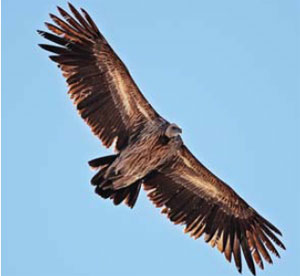
Indian vulture
(Lamothunde Giddha)
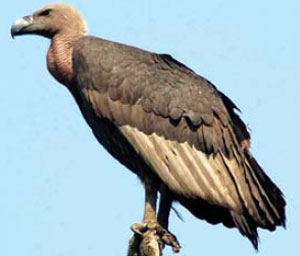
Lammergeier
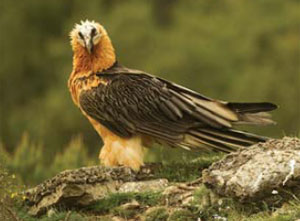
Red-headed vulture
(Sun Giddha)
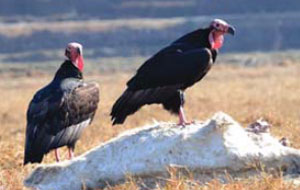
White-rumped vulture (Dangar Giddha)
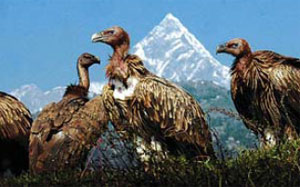
Egyptian Vulture
(Seto Giddha)
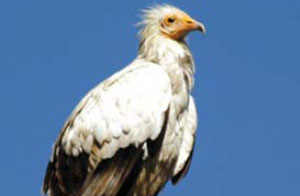
Slender-billed vulture (Sano Khairo Giddha)
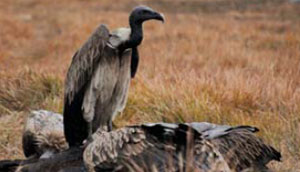
Cinereous Vulture
(Raj Giddha)