
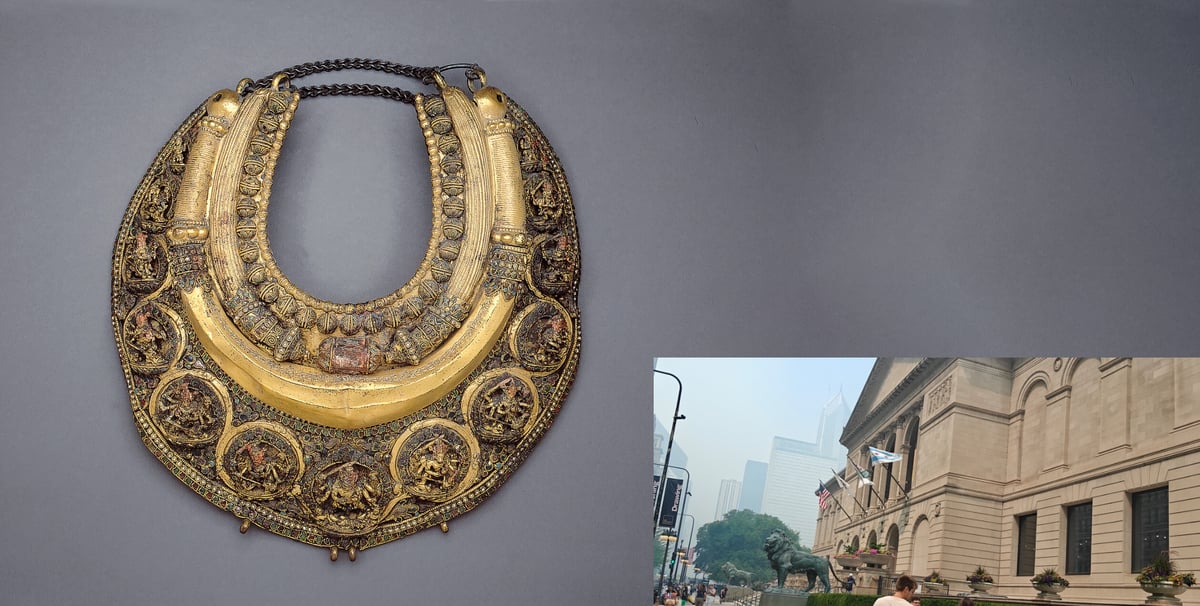
In the sanctum sanctorum of the Taleju Temple dedicated to the matron deity of the Malla kings in Kathmandu was a jewel-studded necklace. In 1970, during the height of the Panchayat regime, it was moved to the nearby Hanuman Dhoka Museum for safekeeping.
Since the Royal Nepali Army guarded the museum, and it was thought the necklace and other sacred treasures would be safer there. They were not. In 1976, the necklace was stolen.
It surfaced nearly 45 years later at the Art Institute of Chicago in June 2021, where it was spotted by a Nepali professor Sweta Gyanu Baniya who knelt in emotional supplication before it. She posted the discovery on social media and wrote about it in a Virginia Tech journal.
The gilt-silver necklace was embossed with semi-precious stones and inlaid with images of the eight astamatrika mother goddesses each slaying the buffalo demon. The necklace would have adorned the Taleju Bhawani when the shrine was opened to public worship only once in a year during Dasain. An inscription on the necklace proves that it belonged to King Pratap Malla who ruled Kathmandu from 1641-74, one hundred years before Kathmandu was conquered by Prithvi Narayan Shah.
The inscription says: ‘Victory to the Mother-Goddess [Bhagavati devi Janani]. Hail! [This] is the necklace of the king of kings, lord of kings, lord of the poets, the victorious Pratapamalladeva (may it be) auspicious.’
“कन्थि।। श्री श्री श्री भगवती देवी जननी जयति:। स्वस्ति महाराजाधिराज श्री श्री राज राजेन्द्र कवीन्द्र जय प्रताप मल्ल देव स कथि जुरो शुभ।।"
Last month during a visit to The Art Institute of Chicago, this correspondent looked for the famous necklace only to find that it had been withdrawn from display. The reason: the US Immigrations and Customs Enforcement (ICE) has received additional evidence of its provenance from the Nepal government proving that it was stolen and sold to a collector.
Earlier this year, the ICE representative at the US Embassy in New Delhi Alka Saxena wrote to the Depart of Archaeology (DoA) in Kathmandu asking for specific proof of country of origin before being sold to the US, if Nepal’s royal family at the time had authority to sell it, if not proof that it did not, and if there was evidence it was illegally sold to a certain Bruce Miller Antiquities by the royal family.
The DoA sent back a diplomatically worded reply. What appears to have clinched proof of provenance besides the inscription on it was a 100-year-old listing in the Taleju inventory that noted (in translation): ‘One gilded necklace with Rajendra Pratap Malla inscribed on it encrusted with pearls and statues of the astamatrika.’
‘चाँदीका पातामा सुनका मलम्बा लाग्याको, पक्का मोतीको घेरा लाग्याको, अष्टमात्रिकाको मूर्ति भयाको, लगनका भगवती देवी भयाको, स्वस्ती श्री राजेन्द्रप्रताप मल्ल भनिएको ठूलो कण्ठी एक...’
“After we sent all this translated proof that the necklace was indeed stolen, the Chicago museum has started the process of repatriating it and withdrawn it from display,” says DoA chief Saubhagya Pradhananga. “The museum is working out the legalities, and it will be back in Nepal this year.”
In June, Nepal’s acting ambassador in Washington, Sharad Raj Aran met the executive chair of The Art Institute of Chicago Leslie Darling, and a representative of the Nepal Embassy in Washington DC visited the Chicago museum asking for the return of the necklace in writing, and it was agreed that immediate steps would be taken to return the necklace to Nepal.
ART VS DEVOTION
Most of the stolen artefacts from Kathmandu Valley at the Chicago Museum are from the James W and Marilyn Alsdorf collection. James died at age 76 in 1990 and Marilyn at 96 in 2019. A 13th century Chaturmukhi Shivalinga and a Nagraj Buddha from the Alsdorf collection have already been returned to Nepal five years ago.
When it was on display at the museum till earlier this year, the caption for the Taleju necklace mentioned that it was sold to the Alsdorf Collection by Bruce Miller Antiquities of Sausalito in California before being presented to the institute in 2010.
“Greater global digital connectivity is helping us track down Nepal’s stolen heritage items, and foreign museums have also started investigating the provenance of items in their possession,” says the DoA’s Pradhananga.
She adds that additional information has emerged about sacred antiquities at the Asian art collection of the Musée Guimet in Paris, and the DoA is collecting documentation to prove their provenance.
A Matrika Necklace from the reign of King Pratap Malla (1641-74 CE) similar to the one now being repatriated from Chicago was being auctioned at the Veilinghuis Loeckx in Gent in Belgium on 17 June year for a minimum bidding price of €1,200. But anti-trafficking activists raised objections and it was withdrawn because of questions about provenance. That necklace had also been stolen from a Kathmandu temple and sold to a collector in Amstredam. Its whereabouts remains unknown.
It costs $30 to enter The Art Institute of Chicago, and the Alsdorf collection of Asian art, statues and photographs greets visitors right near the entrance spread out across two floors. The Alsdorfs seem to have bought many of the artefacts from middlemen who sourced 14 of them from Nepal from as far back as 1976. Some of them were used as decoration around their swimming pool before the couple donated the entire collection of sacred Asian artefacts to the museum in 2010.
The effort to return the necklace and other artefacts to Nepal has stretched to over five years. Last year the US Department of Homeland Security and ICE wrote to Nepal’s DoA to furnish clarficiations on four points as proof of origin of the necklace. One of those questions was about whether Nepal’s royal family at the time had the authority to sell the item.
It seems that the DoA’s reply to those four questions included the clarification that the royal family did not have the jurisdiction to sell the antiquities to a foreign party, which is why the American agencies started the repatriation process.
“We are now expecting the necklace to be returned in the next few months,” Pradhananga told us. She added: “We have proved the necklace’s provenance beyond any doubt with the inventory documentation.”
What has helped is that both the United States and Nepal are signatories of the UNESCO Treaty on the return of stolen antiquities to the country of origin. This has facilitated the return of other objects from US museums like the 800-year-old Laxmi-Narayan which was stolen in 1984 from Patan and was being exhibited at the Dallas Art Museum.