

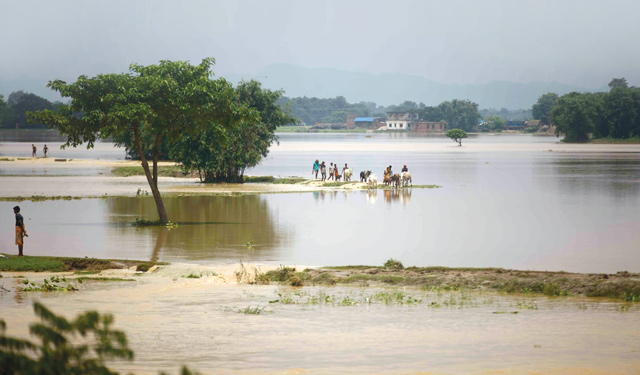
The deaths and devastation caused by this week’s floods in the Tarai were frightful. But what is even more frightening is that this may be just the trailer for even more horrific disasters in the future if we do not manage our rivers right. It may sound like a cliché to say that these were not natural but man-made disasters, but sometimes clichés are more accurate. To understand why these floods are man-made and how future disasters can be prevented, we have to look at the way we are treating our rivers.
Rivers are the arteries of the earth, and the roots of human civilisation. Rivers were there before humans came into existence, freely flowing and nurturing plants and creatures in their courses to the sea. In fact, Nepal’s three main rivers are older even than the mountains, carving through these mighty gorges over the last 65 million years as the Himalaya rose.
But we have desecrated these sacred veins of water. We have exploited them for water, irrigation and energy but also for sand, gravel, boulders and other construction material. We think we can tame rivers by building embankments, or dam them to get rich. But the rivers are fighting back.
There are more than 6,000 rivers and rivulets in Nepal, but we have never cared about managing them sustainably. Isn’t it bizarre that a country with so many rivers does not have a long-term policy or vision to use its resources without destroying them in the process?
When our policymakers discuss rivers, they cannot think beyond sand mining, gravel excavation, sewage or hydropower. Rivers are not just for these commercial purposes, and it is not a sustainable way of managing rivers. Removing sand and boulders from the rivers increases the velocity of the water, making them more destructive. Building embankments and encroaching on the floodplains constricts the rivers, squeezing them so they cannot handle runoff after heavy rainfall.